
The craft
Biography Writing Services: What Families Should Expect to Receive
Biography writing services bundle different deliverables under one name — interviews, research, drafting, approval, an archive. Here's how to tell them apart first.
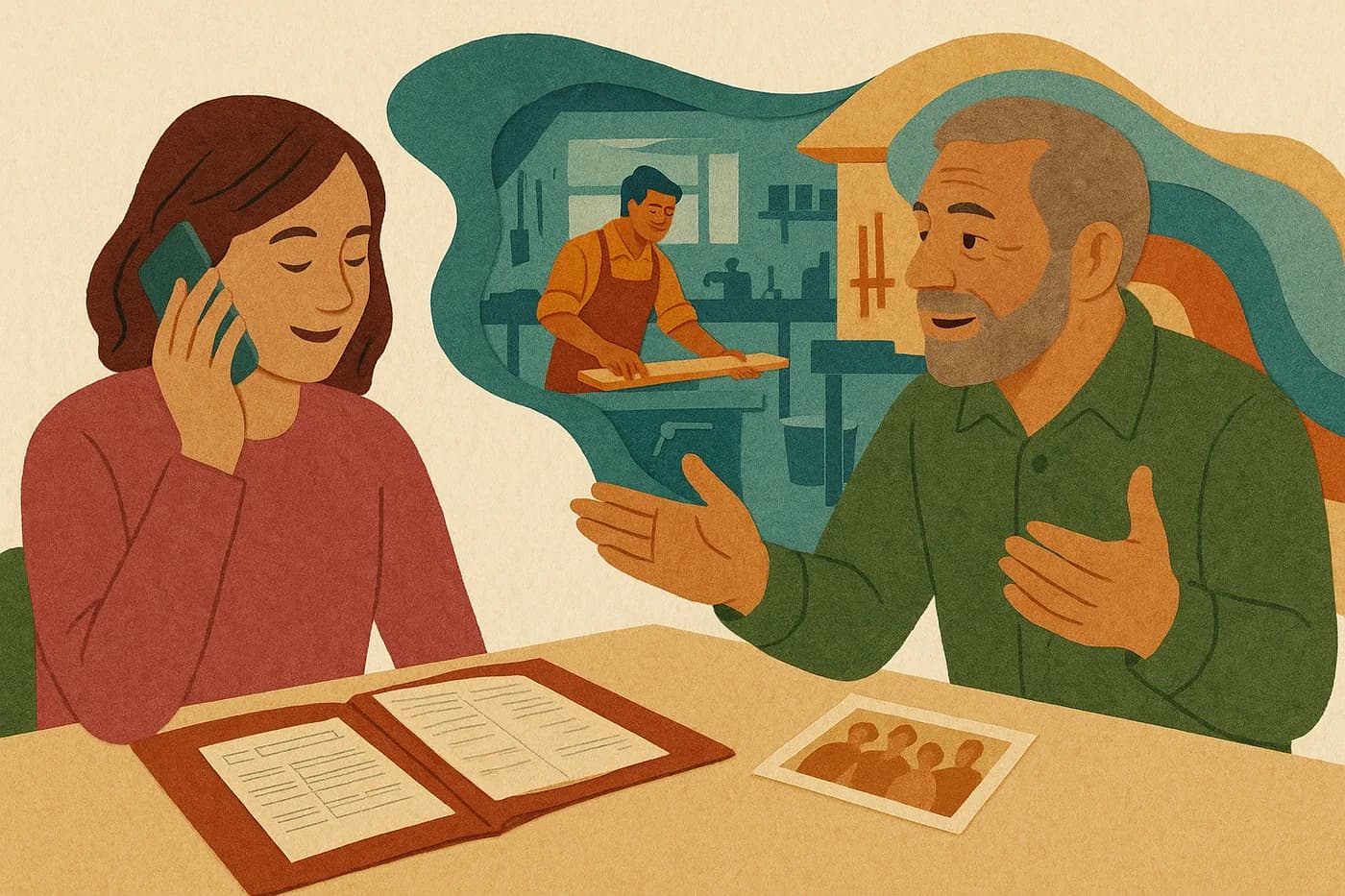
A family usually starts looking for biography writing services after deciding a parent's or grandparent's life is worth a real book, then discovers the search results don't agree on what that book-making process actually involves. Some pages describe a writer who disappears for months and returns with a manuscript. Others describe a series of recorded conversations. A few describe software. The word "biography" is doing a lot of work across very different processes.
Biography writing services typically combine some mix of six deliverables — interviews with the subject, background research to check facts, a written draft, a real approval step, an organized archive of source material, and a finished, printable book. Not every service provides all six, and the ones it skips matter more than the ones it includes. Knowing which six you're actually being offered is the useful comparison, not a feature checklist or a star rating.
What biography writing services actually deliver
The category covers agencies built around professional ghostwriters, independent biographers who work solo, and newer subscription-style products that run conversations over time instead of one long project. What they share is a promise to turn someone's life into a written account. What they don't share is a fixed process for getting there — one service might spend most of its time on original research in public records, while another does almost none and relies entirely on what the subject says out loud.
That variation is the reason a feature list is more useful here than a brand comparison. Six deliverables show up across the category in different combinations:
| Deliverable | What it actually is | Why it matters |
|---|---|---|
| Interviews | Recorded conversations with the subject, once or repeatedly | The primary source — everything else is built on what gets said here |
| Research | Checking dates, places, and records against what memory alone provides | Catches drift without overruling the person who lived it |
| Drafting | Turning conversation and research into readable prose | Determines whose sentences end up on the page |
| Approval | The subject reading and correcting the account before it's final | The only step that makes a chapter more than a draft |
| Source archive | Recordings, transcripts, and documents kept alongside the finished text | What survives if the book itself is never printed, lost, or needs revising |
| Finished book | A printed or bound object, distinct from the material behind it | The object a family holds, not the process that produced it |
A service can be entirely legitimate and still only offer two or three of these. The problem is when a family assumes the other four are included by default.
Whose sentences end up on the page
This is the decision most biography writing services describe least clearly. A ghostwriting model has a professional interview the subject, then go away and produce a manuscript in their own craft — what a family receives is well-made prose, but the voice on the page is a blend of the subject's material and someone else's sentences, usually seen only after most of the writing is already done. A guided-interview model keeps the subject's own words closer to the surface, shaping conversation into a readable account without replacing it with a narrator's paraphrase. Neither approach is wrong on its own terms. A family that wants a polished, bookstore-shelf result on a fixed timeline may prefer the first; a family that wants the account to still sound like the person who lived it usually prefers the second.
The mistake isn't picking either model — it's not knowing which one you signed up for until the draft arrives and the sentences don't sound like anyone in the family recognizes.
Approval belongs to the subject, not whoever is paying
Here is where families run into the sharpest edge of this category. An adult child who commissions a biography about a parent is the buyer, but the buyer is not automatically the person whose approval makes the account final. A biography about someone who is still living isn't finished when a son or daughter reads it and likes it — it's finished when the subject themselves has read it and agreed it can stand, including the right to correct a detail, decline a question, or ask that something be left out entirely. Good intentions on a child's part don't substitute for that read-through, and a chapter the subject hasn't personally reviewed is a draft no matter how final it looks on the page.
The Oral History Association's published guidance on narrator review sets a useful bar even outside a formal oral-history project: the person who told the story reviews the written or recorded account before anyone treats it as settled. Ask any biography writing service, directly, whether that review happens with the subject or with whoever is footing the bill — the answer separates a service built around the storyteller from one built around the customer.
Memory won't always agree with itself, either. A sibling may remember an event one way and the subject another; a biography that quietly resolves every disagreement into one confident version is smoothing over something true. A written account that says "as she remembers it" and leaves both versions standing is more trustworthy than one that erases the disagreement to read cleanly.
What happens to the material afterward
A finished book is the visible product, but the interviews, research notes, and any recordings behind it are the part that actually holds the person's account. Before hiring, it's worth finding out plainly what becomes of that material once the project ends — whether the family keeps the recordings and transcripts, whether the service retains a copy and for how long, and whether anything can be added to later if more conversations happen. A one-time ghostwriting project and an ongoing archive answer that question very differently, and the difference matters more once the initial excitement about a finished book has passed.
Questions worth asking before you hire
- Which of the six deliverables above does this service actually provide, and which are assumed but not included?
- Who writes the sentences that end up on the page — the subject, a ghostwriter, or an interviewer shaping the subject's own words?
- Does the subject personally review and approve the account before it's called finished, or does that step belong to whoever is paying?
- If the subject wants something removed or corrected after the fact, is there a real process for that?
- Do research and fact-checking happen, and does the account note where a document and a memory disagree instead of silently picking one?
- What happens to the recordings, transcripts, and research after the project ends — who keeps them, and can the account grow later?
A service with clear answers to all six is being straightforward about what it does, whichever combination of deliverables it turns out to offer. Vague answers about approval and about what happens to the material afterward are worth treating as a real signal.
Where Joan fits, honestly
Joan runs interviews as paced phone conversations over time rather than a single sitting, keeps the subject's own words rather than a narrator's paraphrase of them, and treats nothing as part of the archive until the subject — not whoever is paying — has reviewed and approved it. The recordings, transcripts, and shaped stories stay together as a growing archive rather than ending at one printed book, though a book can still be one output of that archive. A close look at what memoir writing services actually offer walks through the same deliverable-by-deliverable comparison for a related category, and nothing enters the archive without approval covers the review step in more depth.
That makes Joan a poor fit for a family wanting a single finished manuscript delivered fast with no ongoing process, and a good fit for one more interested in an accurate, growing record that the subject has actually approved, built at the subject's own pace.
Whatever biography writing service you're comparing, the six-deliverable list above holds regardless of the name on the page — find out which of the six you're getting before you find out what it costs.
If you'd rather see how a guided conversation works than take a category's word for it, the first call is free and there's no card.