
The archive
Choosing a Parent Memory Book: Prompts, Voice, Privacy, and What Happens Next
A decision guide to picking a parent memory book — how the prompts work, whose voice ends up on the page, who controls privacy, and what happens after.
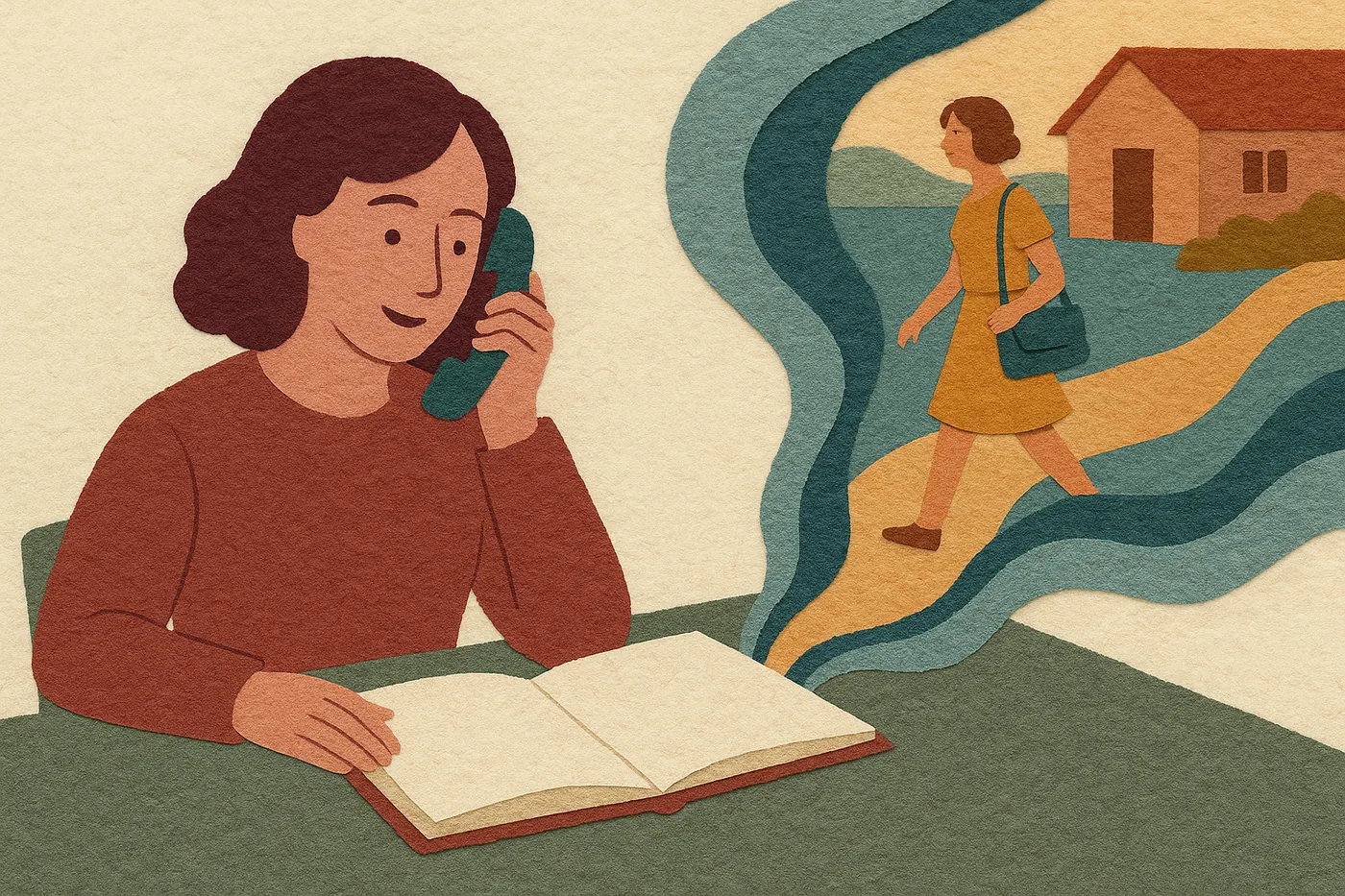
Most families start looking for a parent memory book after a birthday, a health scare, or just a Sunday call that ran long and reminded someone how much they don't know. The options that turn up next look similar from the outside — ruled pages, warm covers, a promise to "capture a lifetime." They are not similar once you look at how each one actually works.
A parent memory book is worth choosing on four things, not one: what kind of prompts it uses, whose voice ends up on the page, who controls what gets shared and with whom, and what happens to the material once the pages are full. Two books can ask the same twenty questions and produce completely different results depending on how those four hold up.
Start with who is choosing, and who is deciding
Here is the distinction most comparisons skip: the adult child is usually the one buying the book, but the parent is the one who has to want to fill it in — and the only one who gets to decide what goes on the page and who sees it. A memory book chosen as a surprise gift and handed over already has a problem the format can't fix: nobody asked the storyteller if they wanted to do this, on this timeline, in this much detail. The better version of the same gift is an offer, not an assignment — a book, or a service, that the parent can pick up, set down, or decline a page of, without having to explain why.
Prompts: a fixed list or an open conversation
Every parent memory book runs on some version of a prompt, and the prompt style is the first real fork in the decision.
| Format | How prompts work | Where it's strong | Where it breaks down | |---|---|---|---| | Pre-printed question book | Fixed questions, fixed order, ruled lines | Fast to start, good for simple facts (names, dates, hometowns) | No room for a follow-up; the next page is already printed regardless of what the last answer contained | | Blank journal or shared document | No prompts at all | No structure to fight | No pacing either — a blank page asks more of a reluctant writer than a specific question does, and most sit empty | | Guided, conversational process | Prompts adapt to what was just said | Follow-up happens naturally; someone else holds the pacing | Requires more coordination than handing over a book |
None of the three is the wrong answer on its own. The mismatch that leaves a memory book half-filled on a shelf is usually a fast, fixed-order format applied to a parent who wanted to talk at length about one thing and skip three others — a pace only a conversational format can actually accommodate.
Voice: whose words end up on the page
Some formats ask the parent to write in their own hand. Others have a family member transcribe or paraphrase what was said. The difference matters more than it looks. A summary in someone else's words is accurate and forgettable; the same story in the parent's own phrasing — the words they'd actually use, including the ones that repeat every time they tell it — is what makes a page sound like a specific person instead of a generic answer to a generic question.
If the format involves anyone other than the parent writing the final version, ask how closely it sticks to what was actually said, and whether the parent gets to see and correct that version before it's treated as finished. The Oral History Association's published guidance on narrator review — letting the person interviewed check and correct the record before anyone calls it final — applies just as well to a family memory book as to a formal oral history.
Privacy: who controls what gets shared, and with whom
This is the question a surprise gift skips past, and it shouldn't be skippable. A parent memory book usually asks about marriages, money, grief, estrangement, and things a person might not want printed and passed around at a reunion. Before choosing a format, it's worth knowing:
- Can a page be marked private, or shared with only some people?
- Can an answer be skipped without the book treating it as unfinished?
- If the book becomes a shared document or an app, who else has access, and can that access change later?
- Is there a way to change an answer, or remove one, after it's already written down?
A parent's stories belong to the parent. A book, app, or service that doesn't leave room for "not this one" or "not yet" is asking for more disclosure than it has any right to, no matter how warm the cover looks.
What happens after the pages are full
This is the part most comparisons never get to, because most memory books are sold as a single finished object rather than a process with an end state. Worth asking before buying: Can more be added later, or is the book done once the last page is filled? If a story turns out to be remembered differently by two people, is there room to note the disagreement, or does the format force one version to win? And if the physical book is lost, damaged, or simply outgrown, does anything survive it — a digital copy, a set of recordings, a document — or was the printed book the only copy that ever existed?
None of this is meant to talk anyone out of the simplest option. A pre-printed prompt book, filled in over a slow year at the kitchen table, is a completely reasonable choice for a family that wants exactly that. The point of asking the four questions is to know which trade-offs you're making, not to find the one format with none.
A four-question rubric for any parent memory book
Before choosing a format, run it against these:
- Prompts — Does a short answer invite a follow-up, or does the book move on regardless?
- Voice — Does the parent's own phrasing survive, or does it get smoothed into someone else's summary?
- Privacy — Can the parent skip a question or mark an answer private, and does that choice hold later?
- After — Can the record grow past the last printed page, and does anything survive if the book doesn't?
A format that answers all four well is worth the price on the cover. One that answers none of them is still better than nothing — just worth choosing with the trade-offs in view rather than assuming the warmest-looking cover has already handled them.
Where this fits with a family memory book generally
This piece is about choosing a format; A Family Memory Book Should Keep Stories, Not Just Answers makes the broader case for what any format — printed, digital, or guided — needs to preserve to be worth keeping at all. And because privacy is one of the four questions above, Nothing enters the archive without approval lays out, in more detail, what storyteller approval should actually mean in practice.
Joan is built as the guided, conversational option in the table above: pacing and follow-up held by someone else, the parent's own words kept rather than paraphrased, and nothing entering the archive until they've approved it themselves.
If your family is ready to offer that instead of hand over a blank book, join Founding Families.