
Family stories
Becoming a Grandparent for the First Time: What Suddenly Becomes Worth Writing Down
Becoming a grandparent for the first time changes what feels worth remembering. What to capture in the first year, and why it beats waiting until a grandchild is old enough to ask.
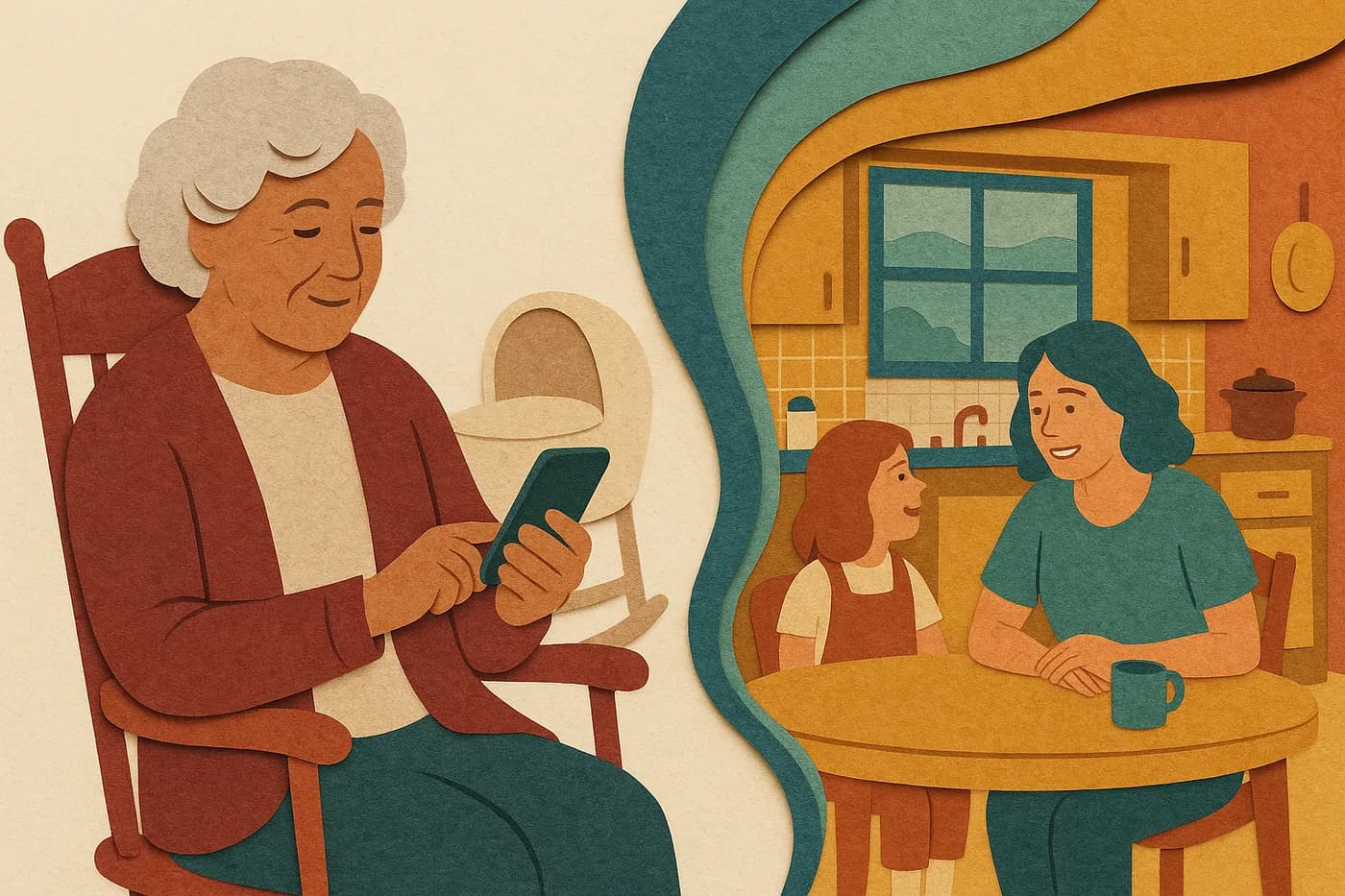
Nobody tells you that becoming a grandparent for the first time will make you think about your own childhood more than the baby's. Meeting your grandchild does not just add a name to the family — it puts you, for the first time, in the position of being the person a child will one day want to know everything about. That reframes a life. Things you never thought to write down suddenly look like the parts someone will ask for later.
Becoming a grandparent for the first time is the moment most people first feel the pull to record their own story, not just document the baby's. The practical answer is to start now, in the first year, while the impulse is strong and the memories are still easy to reach — rather than waiting for a grandchild old enough to ask, by which point a decade or more of specifics will already be gone.
Why this transition changes what feels worth remembering
A first grandchild does something a birthday or a retirement rarely does: it puts a specific, named future person on the other end of your life story. Before, "someone might want to know this someday" was abstract. Now there is an actual person, however small, who is going to grow up wanting to know who their grandparent was before they arrived — what their grandparent's own childhood kitchen smelled like, what they were afraid of at twenty, how they met the grandchild's other grandparent, what they got wrong and figured out.
That shift is not sentimentality. It is a genuine change in audience. A person writing or recording their life story "for the record" is writing into the abstract. A grandparent doing it in the months after a birth is writing to someone specific, which tends to produce sharper, more concrete material — the kind of detail that answers a real question instead of performing a general one.
The problem with waiting until they're old enough to ask
The instinct to wait is understandable: a newborn cannot ask questions, so it feels premature to start answering them. But the material that makes a life story feel like a particular person — rather than a biography anyone could have written — comes from memory that is still fresh, not memory that has had fifteen more years to flatten.
By the time a grandchild is old enough to ask "what was it like when I was born," a grandparent's memory of that exact period has already been overwritten by everything since. The specific weather, the drive to the hospital, what was said in the first phone call, which relative cried and which one made a joke — these details are sharpest in the first year and get vaguer every year after. Waiting does not preserve the story. It just moves the recording to a point where less of it is left to record.
There is also a second cost to waiting that has nothing to do with memory: health, distance, and time are not guaranteed. A grandparent who is present and well now may not be reachable for a long, unhurried conversation a decade from now. Starting in the first year is not about urgency for its own sake — it is about using the window while it is open, the same way anyone would with any limited window.
The three questions worth answering now, before they're asked
Most of what a grandchild eventually wants to know from a grandparent falls into three categories, and all three are easier to answer accurately in the first year than fifteen years later.
- Who were you before I knew you? Not a résumé — a childhood, a first job, a person you were before anyone called you "grandma" or "grandpa." A grandchild only ever meets the grandparent version. Everything before that has to be told, or it disappears with the person who lived it.
- What did becoming a grandparent actually feel like, for you specifically? Not the general sentiment everyone expects ("indescribable," "the best day") but the specific, sometimes contradictory feelings — nervousness about a second chance at something, an old memory of your own parents that resurfaced, a fear you didn't expect to have. That texture is only available while the feeling is recent.
- What do you know about my parent as a child that I'll never get to see myself? A grandparent holds a version of the grandchild's own parent that the grandchild has no other access to — the stubborn toddler, the kid who was scared of the dark, the teenager who slammed doors. That account only exists in the grandparent's memory, and only for as long as the grandparent is around to give it.
None of these three questions requires a formal project. They are simply the questions a grandchild will eventually wish someone had asked — and the first year after becoming a grandparent is the easiest, most naturally motivated time to start answering them.
What to capture in the first year
The first year gives a grandparent a series of small, specific occasions that are easy to build a record around, without turning the whole thing into an assignment:
- The first meeting. Where it happened, who was there, the first thing said or thought — written or recorded within days, while it is still exact rather than smoothed into a general memory.
- The name. Why the name was chosen, whether it carries family history, and what the grandparent thought of it on first hearing it.
- The first holiday or milestone. Whatever comes first — a first Thanksgiving, a first birthday, a first trip — is a natural occasion to record a short reflection, not just take a photo.
- A memory it brought back. New grandparents often find an old memory of their own resurfacing — their own parents, their own first year as a parent, a detail from their own childhood they hadn't thought about in decades. These resurfacing memories are some of the most valuable material in the entire process, and they tend to arrive unannounced and fade quickly if nothing is written down.
- One piece of family history worth passing down now. A recipe, a phrase, a habit, a story about where the family came from — chosen deliberately, before it becomes one more thing assumed to be common knowledge that turns out not to be.
None of this needs to happen in one sitting. A few sentences after each occasion, gathered over the year, will hold more real detail than one long attempt to summarize everything at the end of it.
Start without turning it into a project
The easiest way for this to stall is to treat it as a single large task — "write my life story" — which is exactly the kind of open-ended assignment most people postpone indefinitely. It works better as a habit tied to occasions that are already happening: after the first visit, after the first holiday, after a memory resurfaces unprompted. A short voice memo or a few written lines, close to the moment, beats a blank document waiting to be filled all at once.
It also helps to accept in advance that not every question needs an answer right away, and that some memories will come back in a different order than expected. Memoir prompts that lead somewhere better than a blank page groups a starting set of questions into threads rather than a flat checklist, which suits this stage well — one opening question, a couple of natural follow-ups, and permission to stop wherever the thread runs out for now.
Where the record should live
A first-year record like this only stays useful if it lives somewhere the rest of the family can actually find it later — not scattered across text messages and a single photo album. A family memory book should keep stories, not just answers makes the case for a format built around follow-up and disagreement rather than one built like a questionnaire, which matters here too: a grandparent's account of their own first year in the role, and a parent's account of the same year, will not always match, and a good record keeps room for both rather than forcing one version.
Joan is built for exactly this kind of gradual, occasion-by-occasion record — a standing conversation, paced over weeks and months rather than crammed into one sitting, with follow-up built in and nothing entering the archive until the storyteller has approved it. If becoming a grandparent is the thing that made you want your own story kept somewhere real, join Founding Families and start while the first year is still happening, not after it has already become a memory of a memory.