
The archive
How to Build a Family History Photo Book People Actually Read
A family history photo book needs more than good photos: captions that hold who, when, where, confidence, and the story just outside the frame.
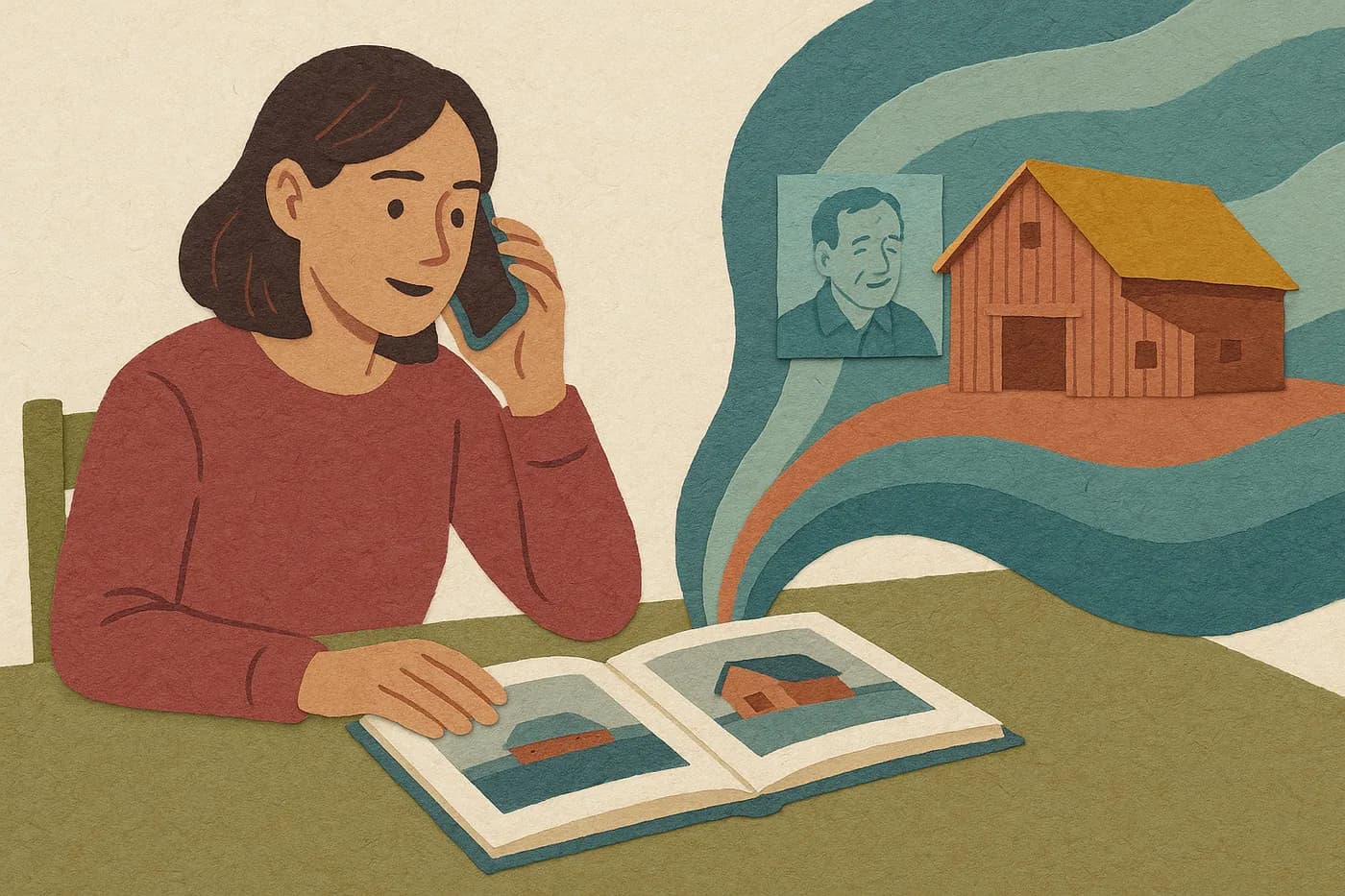
Most family history photo books get built the same way: pick the best-looking prints, drop them into a template, add a name and a date underneath. The book looks finished. It usually isn't, because a caption that only says who and when leaves out the reason the photo was worth keeping in the first place.
A family history photo book that still means something years later needs four things under every photo, not one: who is in it, where and roughly when it was taken, how sure anyone actually is, and the story that happened just outside the frame — the thing the camera didn't catch that explains why this picture, of everything that could have been photographed that day, is the one someone kept. Photos with only the first two are decoration. Photos with all four are a record.
Why "name and date" isn't a caption
A caption that says "Grandma Ruth, 1958" answers a fact-check, not a question a reader actually has. It doesn't say who took the picture, why it was taken, what was happening the moment before the shutter clicked, or whether anyone in the family agrees on any of it. Most of that information exists only in someone's head, and it doesn't survive the photo's transfer from a shoebox to a printed page unless somebody deliberately asks for it and writes it down.
This is the gap that turns a photo book into a coffee-table object nobody opens twice. The pictures are accurate. They just don't tell anyone anything they didn't already know from looking.
Choosing which photos actually belong
A family history photo book is not the place for every usable print in the box — it's the place for the photos that carry a story, which is a smaller and different set than "photos that turned out well." Before laying out a single page, sort candidates into three piles:
- Carries a story someone can still tell. A photo where a living relative can supply who, where, and what was happening. These come first.
- Documents something the family agrees mattered. A wedding, a move, a house that no longer stands — historically significant even if nobody remembers the exact moment.
- Just a good photo. Technically fine, emotionally flat, no story attached. These fill space without adding anything; leave most of them out.
A shorter book built entirely from the first two piles will get reread. A longer one padded with the third pile usually won't.
What a full caption holds
Five fields, not two, turn a photo into something a reader can actually use:
| Field | What it captures | Example |
|---|---|---|
| Who | Everyone identifiable, by relationship | "Ruth (center), her brother Tom, cousin unidentified" |
| Where and when | Place and approximate date | "Side yard of the Elm Street house, around 1961" |
| Told by | Who supplied the information, and when | "As Tom remembered it, 2026" |
| Confidence | How sure anyone actually is | Certain · fairly sure · best guess · unknown |
| Outside the frame | What happened just before or after, or why the photo was kept | "Taken the morning they found out the house had sold" |
The last field is the one most family history photo books skip entirely, and it's the one that makes a caption worth reading rather than skimming past.
The story outside the frame
A photograph shows a single frozen second. Almost everything that made that second worth photographing happened just outside it — the argument the family had the night before, the fact that this was the last photo taken in that kitchen before the family moved, the joke someone was mid-laugh at when the shutter caught them looking away instead. None of that is visible in the print. All of it is usually still recoverable, if someone asks for it before the person who remembers is gone.
Two questions do most of the work:
- "What happened right before, or right after, this was taken?" Photos rarely exist in isolation — there's a reason the camera came out at that specific moment, and the reason is often more interesting than the image itself.
- "Why did this photo get kept, out of everything else from that day?" A photo that survived decades of moves and purges usually survived because it meant something to someone. Asking why it was kept often surfaces the actual story, where asking "what is this a picture of" only produces a description.
This is the one contribution a caption can make that the photograph alone never will, and it's the difference between a book of pictures and a book of stories that happen to have pictures attached.
When two people remember the same photo differently
This will happen on almost every photo book with more than one living contributor, and it isn't a problem to resolve — it's information to keep. If one sibling says a photo was taken at a lake house and another says it was a neighbor's yard, record both accounts with who said what, rather than picking the version that sounds more confident. A remembered account is not the same kind of evidence as a dated negative, and two people can disagree about a decades-old afternoon without either one being wrong.
The Oral History Association's published guidance on narrator review — showing a person how their account was recorded and letting them correct it before it's treated as final — applies directly here. Read a finished caption back to whoever supplied it before the book goes to print. People often remember a second detail once they see the first one written down.
Structuring the book so it reads front to back
Strict chronology sounds like the obvious structure and is usually the wrong one for a multi-branch family, because it scatters every person's story across dozens of unrelated pages. A structure that groups photos by person or family branch, and moves chronologically within each section, tends to read better: a reader can follow one person's life in sequence, then move to the next branch, rather than jumping between six different households every few pages. Reserve strict chronology for books built around a single person or a single household, where the timeline is the story.
Whatever structure is chosen, a short table of contents up front and a one-line "who's who" page for the family's branches make the book usable by someone who didn't grow up hearing these names — which, within a generation or two, is most of the people who will actually open it.
A caption worksheet to bring to the table
Print or copy this before sitting down with a photo and whoever remembers it:
- Photo location or box, so it can be found again
- Who is in it, by name and relationship
- Where and roughly when it was taken
- What happened just before or after, in the storyteller's own words
- Why this photo, out of everything from that day, was kept
- Who supplied the information, and the date
- Confidence: certain / fairly sure / best guess / unknown
- Anything the storyteller wants noted but not shared further
That last line matters as much as the first. Not everyone wants a story attached permanently and reprinted without limits, and asking is part of building the book, not an afterthought to it.
Where this fits inside the larger archive
A finished photo book is a snapshot of whatever had been gathered by the time it went to print — a fixed export, not the whole record. How to Make a Family History Book People Will Actually Read makes the broader case for connecting names and dates to scene, decision, and quotation; a photo book is the same idea applied to images instead of prose. How to organize old family photos before nobody knows who is in them covers the earlier step — interviewing and labeling the loose collection a photo book eventually gets built from.
Joan works from that same principle: the paced conversation and the storyteller's own account are the lasting record, and any book — photo or otherwise — is one export of it, made only with what the storyteller has approved.
If your family is ready for someone else to hold the pacing and the follow-up, join Founding Families.