
The archive
A Family History Book Template Built Around People and Stories
A reusable family history book template: chapter structure, the metadata each entry needs, and an approval checklist to run before anything is printed.
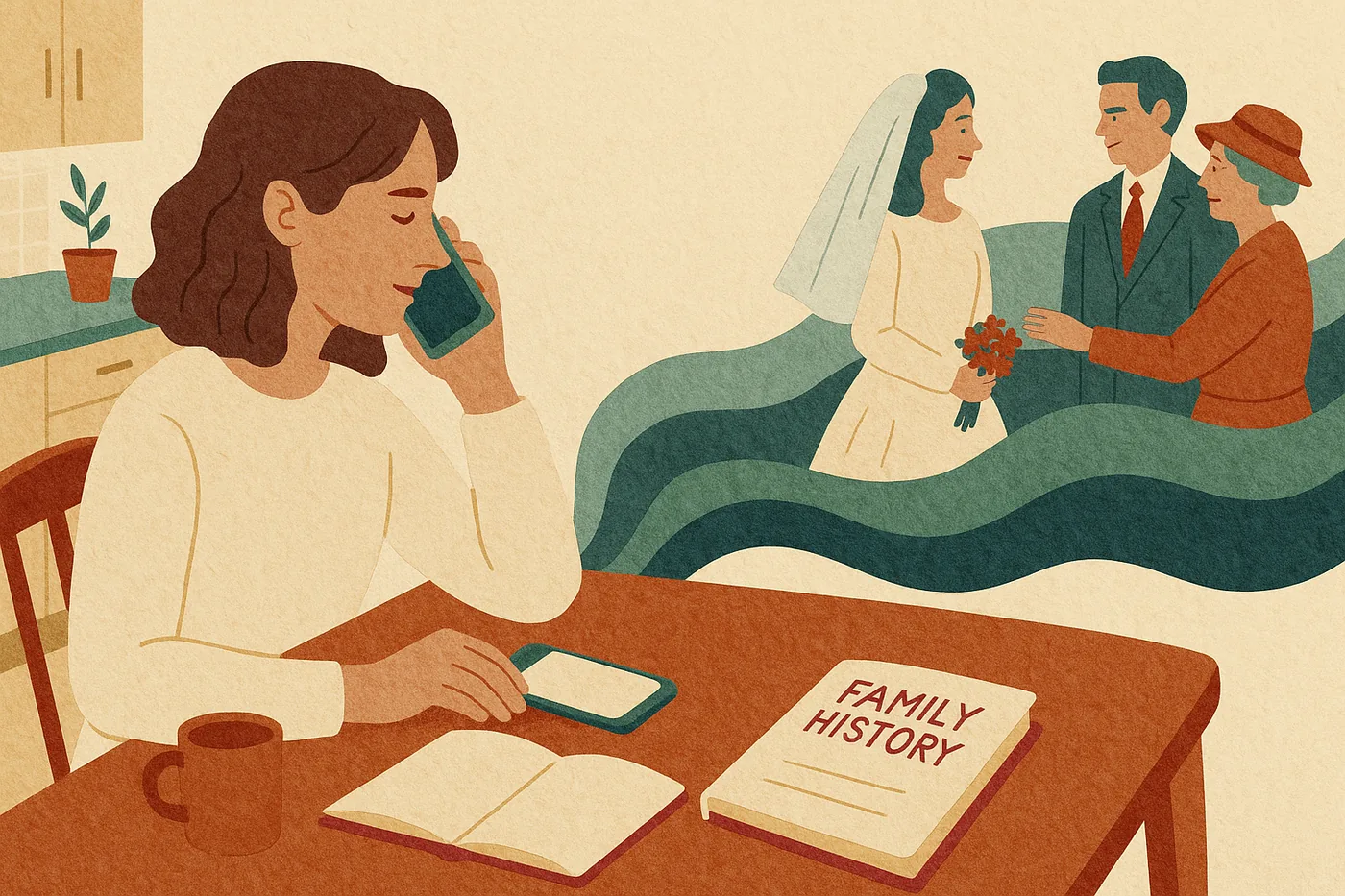
Most people start a family history book with a blank document and a list of names, and the project stalls somewhere around the third relative because nothing tells them what to do with what they've gathered. A template fixes that — not a fill-in-the-blank form, but a repeatable structure for turning one conversation into one finished chapter.
A useful family history book template has three parts: a chapter structure that repeats for every person, a metadata field for each entry so a reader can tell how solid the information is, and an approval checklist run before anything goes to the printer. The structure below is designed to be copied as-is, or adapted to however your family's stories actually come in.
Why a template beats a blank page
A blank page asks a family historian to decide, from scratch, what belongs in a chapter about their grandfather. That decision is hard the first time and inconsistent every time after — one chapter ends up three pages of dates, the next is a page of scattered memories, and nothing reads like it belongs in the same book.
A template removes that decision. It says: every chapter gets the same slots, filled with whatever material this particular person's life produced. Some slots will be thin. That's information too — it tells a future reader where the record is solid and where it depends on one person's memory.
The chapter structure
Repeat this structure for every person in the book. Not every slot will have much in it for every person, and that's expected — a template's job is to make the gaps visible, not to hide them.
- Identity block. Full name, any names they went by, birth and death dates (or "living" and the date the chapter was written), and their relationship to the book's central family line.
- Orientation scene. One specific moment — a kitchen, a porch, a workplace — that gives a reader a place to picture this person before the facts start arriving. This is the paragraph that makes the chapter feel like a person rather than an entry.
- Turning points. Two to five moments where something changed: a move, a marriage, a job lost or taken, a decision that shaped what came after. Each one gets a sentence on what was true before and what was true after — the shift is usually more interesting than the date.
- In their own words. Direct quotations, not paraphrase. Even one or two real sentences, kept exactly as spoken or written, do more than a paragraph of summary.
- What's remembered differently. If two relatives tell a story two ways, both versions belong here, attributed by name, rather than one smoothed-over account.
- Source notes. Where every claim in the chapter came from — see the metadata fields below.
How to make a family history book people will actually read goes deeper on why scene, decision, quotation, and provenance are the four things that make a name readable rather than filed — this template is where those four elements get a fixed place to live.
Metadata fields for every entry
Every fact in a family history book carries a different amount of certainty, and a template should make that certainty visible instead of flattening everything into the same confident sentence. Track four fields for each entry, even informally:
| Field | What it captures | Example | |---|---|---| | Source type | Where the information came from | Marriage certificate, letter, remembered conversation, photograph caption | | Who provided it | The person who told or found it | "As Aunt Carol remembered it, 2026" | | Date recorded | When this version was written down | Protects against a detail quietly drifting over years of retelling | | Confidence | How sure anyone is | Verified document, single memory, family legend with no known source |
This does not need footnotes or a bibliography page. A short line under a story — "as Uncle Ray told it, 2026" or "from the 1954 letter, kept by his daughter" — is enough, and it is the single habit that keeps a family history book from turning a guess into an accepted fact simply because it was written down first.
Building one chapter, start to finish
Start with the orientation scene, not the identity block — asking "where were you when" produces a place and a moment, while starting with dates tends to produce a list. Once the scene is on the page, the turning points usually surface on their own, because a person describing one memory in detail will often mention what led into it and what came after.
Save direct quotations as you go rather than reconstructing them later from memory of the conversation. A phrase like "we didn't have money for a honeymoon, so we drove to the lake and called it one" is worth more accurately transcribed than beautifully paraphrased. If a detail comes up differently in a second conversation with someone else, add it to the "what's remembered differently" slot instead of quietly picking the version that sounds more finished — the Oral History Association's published guidance on narrator review holds up as a useful standard here even outside a formal interview: let the person who told the story see the written version and correct it before it's treated as settled.
Leave any slot blank rather than filling it with an invented detail to make the chapter feel complete. A thin chapter with real, sourced material is more useful to the next generation than a full one with guesses smoothed in.
The approval checklist before it goes to print
Run every chapter against this list before the book is finalized. A chapter can be genuinely good and still fail two or three of these — that's a reason to go back to the source, not a reason to skip the check.
- [ ] Has the person the chapter is about (or their closest living relative, if they're no longer here) seen the written version?
- [ ] Does every quotation match what was actually said, not a tidied-up version of it?
- [ ] Does every entry have a source noted, even an informal one?
- [ ] Are competing memories of the same event both present, rather than one resolved into "the" version?
- [ ] Is there anything in the chapter the person asked not to include? Has it been removed?
- [ ] Would a reader who never met this person come away with a specific sense of who they were, not just when they lived?
That first question matters most and is the easiest to skip under a printing deadline. A family history book someone didn't get to review before it was printed is a book they didn't actually approve — and a subject, living or being described by people who knew them, gets to correct the record or decline a question before it becomes permanent.
Where the template runs out
A template can hold structure. It can't gather the material that fills it, and the slots that stay empty are usually the ones nobody had a plan for revisiting — a follow-up question three weeks later, after something jogged a memory the first conversation didn't reach. The archive is the product, not the book makes the case for treating the underlying recordings and transcripts as the lasting record, with any printed book — template and all — as one export of it rather than the only copy.
Joan is built around that same idea: conversations paced over time instead of one long interview, a storyteller's own words kept rather than paraphrased, and nothing entered into the archive without their approval.
If your family is ready for someone else to hold the pacing and the follow-up, join Founding Families.