
Conversations
Family History Interview Questions That Connect Facts to Lived Experience
Genealogy records give you names, dates, and places. These family history interview questions turn each record type into a conversation that recovers the motive, relationship, and context behind it.
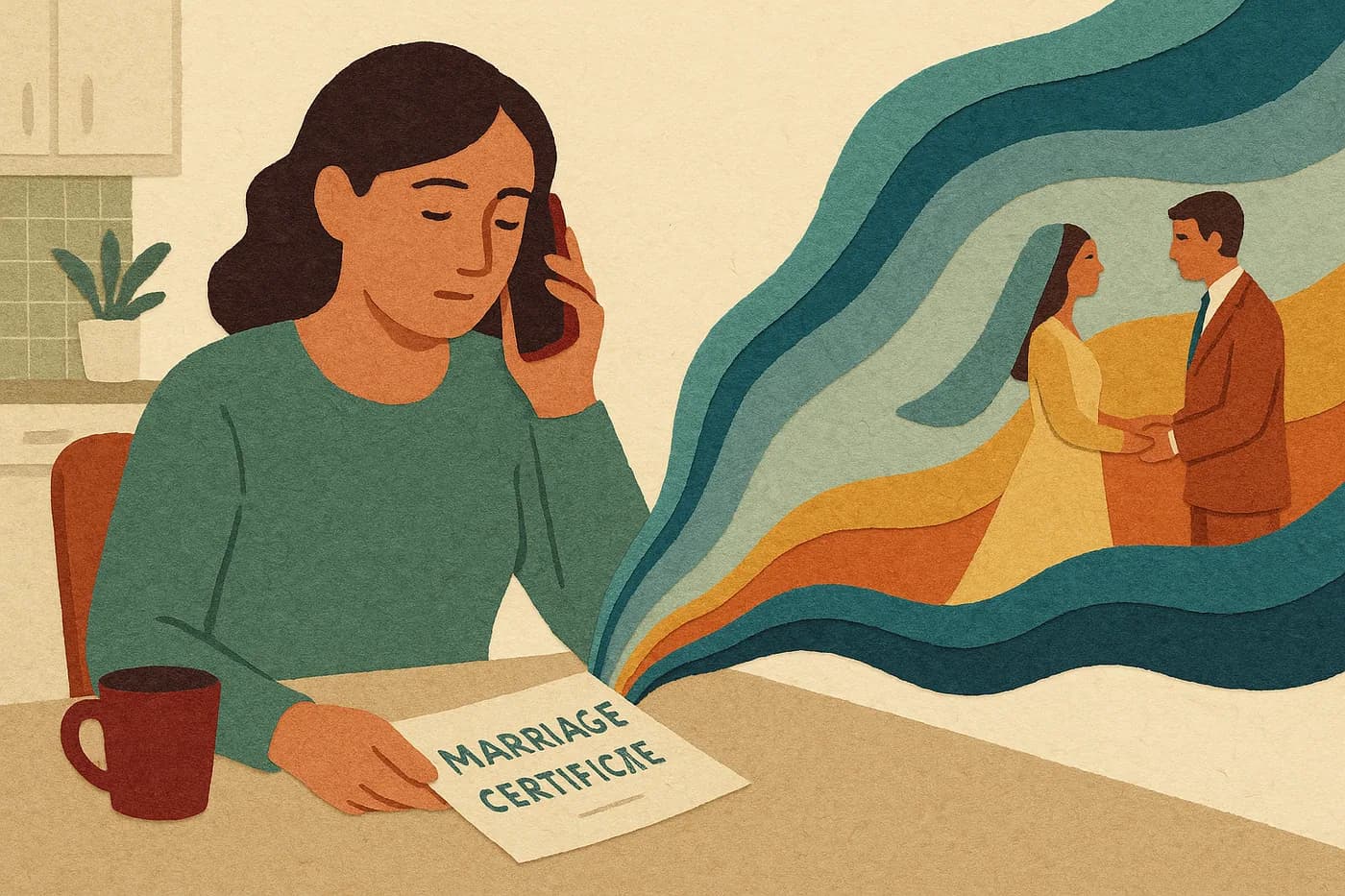
A birth certificate says where and when. It does not say why a family chose that name, who was in the room, or what changed the week after. Family history interview questions exist to fill that gap — not by replacing the record, but by asking the person who lived near it what the record leaves out.
The fastest way to build that question list is to work backward from whatever records you already have. Each record type — birth, marriage, a move, a job, a service record, a death — implies its own family history interview questions, because each one names an event without naming the reasoning behind it. What follows is that record-to-question bridge, plus how to sequence the conversation and where to write down what you learn.
What the paper trail leaves out
Genealogy records are built to be searchable, not to be true to a person's experience of their own life. A census taker recorded an occupation in one word; the work itself might have been six years of a trade the person hated, or the one job that let them support four siblings. A marriage record lists a date and two names; it says nothing about how the couple met, who objected, or what almost stopped the wedding.
None of that is a flaw in the record — it is just not the record's job. It is the interview's job. Every fact you already have on paper is a door into a question the paper cannot answer.
Turn each record type into a question
Bring the actual record, or a copy of it, to the conversation if you can. Naming the specific document — "I have your parents' marriage certificate from 1961" — gives the person something concrete to react to, which usually works better than an open request to "tell me about your parents' marriage."
| Record | What it tells you | What to ask instead |
|---|---|---|
| Birth certificate | Name, date, place, sometimes a witness | Who chose the name, and why? Who was there that you've heard about, even if you don't remember it? |
| Marriage record | Date, place, officiant | How did they meet? Did anyone in the family object, and why? What almost didn't happen? |
| Census entry | Address, household, listed occupation | What did that job actually involve day to day? Who else lived in that house who isn't on the form? |
| Immigration or travel record | Ship, port, date, sometimes an address they were heading to | Whose decision was it to leave? What did they leave behind on purpose, and what did they wish they'd brought? |
| Military record | Branch, dates of service, rank | What did they say about it, if anything? What didn't they say? Who did they stay in touch with afterward? |
| Deed or property record | Address, purchase date, sometimes a price | How did they choose that place? What was the neighborhood like when they arrived, and how did it change? |
| Death certificate or obituary | Date, cause, listed survivors | Who wasn't listed that should have been there? What do people remember about the days right before? |
The right-hand column is the actual interview. The record only supplies the door.
Ask about relationships the records don't show
Some of the most useful family history interview questions have no record behind them at all — they exist because a household, not a form, is where relationships actually happened.
- Who in the family were you closest to, and was that the person you were "supposed" to be closest to?
- Was there someone the family talked about but rarely saw? What was the real story, as far as you know it?
- Whose version of a family disagreement have you never heard — and do you know why?
These questions can surface old friction alongside the warmth. That is not a reason to skip them. A family history that only records agreement is not more accurate for leaving the disagreement out; it is just thinner.
Sequence the conversation from record to relationship
Start with whatever record prompted the conversation — it gives the person something specific to hold onto and is easy to answer factually before it turns personal. Move from there to the "what did that actually involve" questions, which ask for detail without asking anyone to characterize a relationship yet. Save the relationship and disagreement questions for once the person has been talking for a while and the conversation has some trust built into it. End on a question with no record behind it at all, so the last thing you ask is about a person, not a document.
As with any oral history conversation, the person being interviewed sets the pace. Oral history interview questions that open a real conversation covers pacing, follow-up, and the right not to answer in more depth — the same rules apply here, whether the prompt is a photograph or a photocopy of a deed.
Write down the record and the answer together
The artifact worth keeping from this kind of interview is not just the recording — it is the record and the story stapled together, because that pairing is what a plain genealogy chart can't hold. For each record you bring to a conversation, note: the record type and date, the fact it states, the question you asked, and a short summary of the answer, including anything the person disagreed with or wasn't sure about. Keep the uncertainty in the notes rather than smoothing it into a clean sentence — a family member's best recollection of a decision made sixty years ago is not the same thing as a verified fact, and treating it as settled does a disservice to everyone who remembers it differently.
That log is also what makes a later project — a family history book, a labeled photo archive, a timeline for grandchildren — possible to build without redoing the interviews. The Oral History Association's published practices treat this kind of documentation, alongside informed consent, as part of what makes an interview usable later rather than just memorable in the moment.
Where these questions lead
A record-by-record interview like this one produces exactly the kind of material a family history book needs to feel like more than a chart with captions — names connected to reasons, and dates connected to the day someone actually remembers.
If your family has a stack of records and no time to turn them into these conversations, join Founding Families and let someone else hold the questions and the pacing.