
The archive
A Family Legacy Book Is About What Carries Forward
A family legacy book pairs the values a family wants to keep with the stories that carry them — never a list of lessons. Includes a worksheet for that pairing.
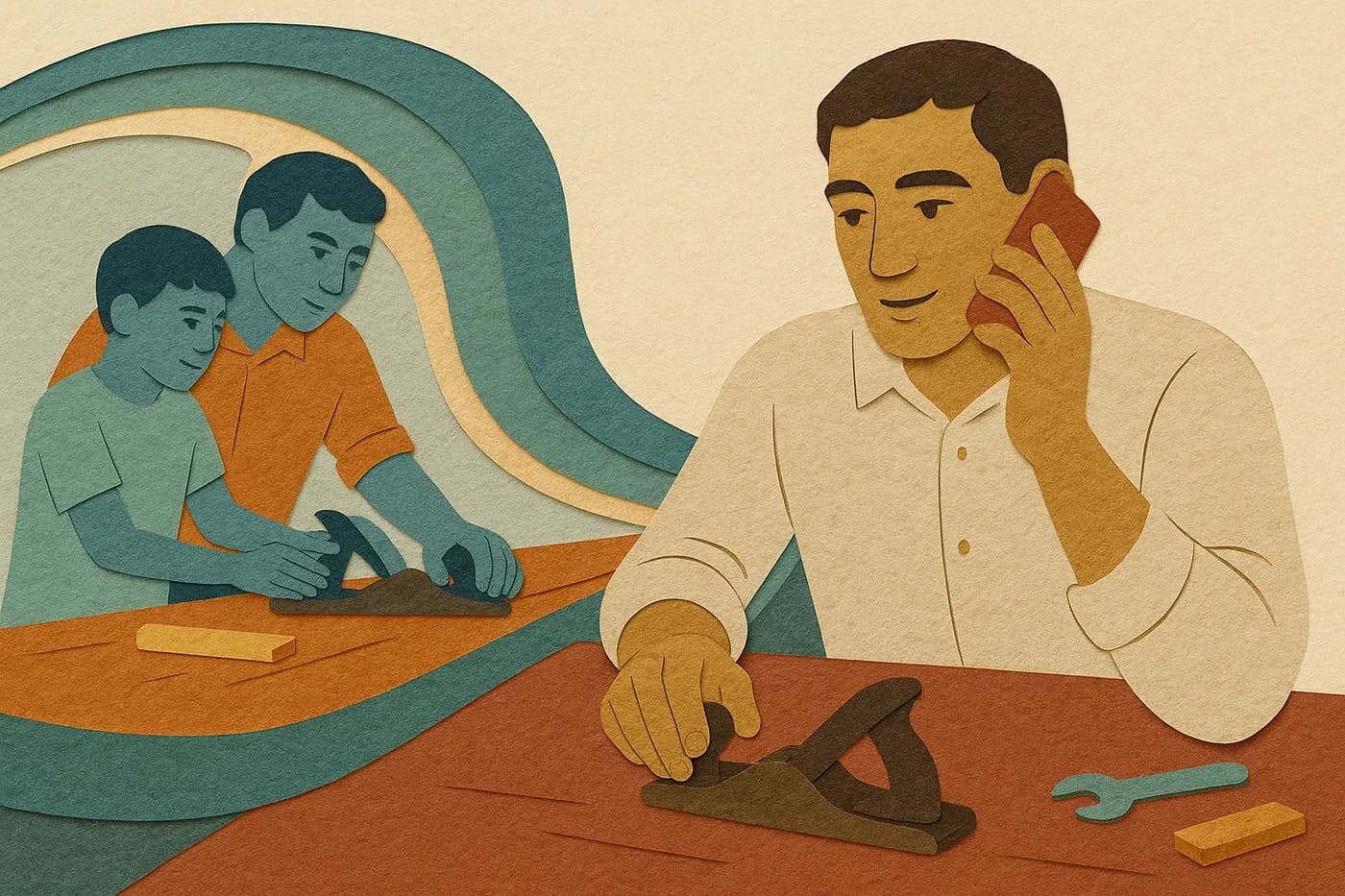
Ask someone what they want a family legacy book to hold, and most people answer with values: hard work, faith, generosity, showing up. Ask them for a story that proves it, and the values get interesting fast — because a value stated on its own sounds like a plaque, and a value attached to what actually happened sounds like a person.
A family legacy book is not a family tree and not a list of life lessons. It is the set of values a family wants to carry forward, each one paired with the specific, sourced story that shows it happening — not a summary of the value, and not a moral pulled loose from the event that produced it. The pairing is the whole job. A value without its story is a slogan; a story without its value is just an anecdote nobody knows what to do with.
How a legacy book differs from a family history book
A family history book answers "who was this person and when did things happen to them" — it wants scenes, decisions, quotations, and provenance attached to names and dates. A family legacy book asks a narrower question: what did this person believe strongly enough that it shaped how they acted, and where is the proof?
The two overlap — a well-built family history book already contains most of the raw material a legacy book needs — but they read differently. A history book can hold a full life in rough chronological order. A legacy book is organized by value, not by year, and it is shorter on purpose: it exists to answer one question the reader might ask years from now — what did she actually care about, and how do I know?
The list-of-lessons trap
The fastest way to ruin a family legacy book is to skip straight to the lessons. "She taught us that family comes first." "He believed hard work pays off." These sentences are true and also almost worthless, because they could describe nearly anyone's grandparent. A list of virtues with names attached is not a legacy — it is a greeting card with better sourcing.
The trap is subtle because it feels like progress. Interviewing a parent or grandparent about their life produces dozens of small stories, and the instinct is to distill each one down to its moral so the book reads as wisdom rather than anecdote. That instinct should be resisted. The moral is the least interesting part of the story, and it is also the part every reader can supply for themselves. What they cannot supply is the specific Tuesday it happened on.
Pairing a value to the story that carries it
Work backward instead of forward. Do not start with a value and search for a story to illustrate it — start with a story someone actually tells, more than once, unprompted, and ask what it is doing there. A story a family keeps retelling is usually carrying a value nobody has named out loud, and naming it after the fact is more honest than assigning a lesson to a story that was never really about that.
A workable pairing has three parts:
- The story, as told. Not summarized — the actual scene, in enough detail that a reader who never met the person can picture it. Keep the person's own words wherever they exist.
- What it shows, stated plainly. One sentence, written after the story rather than before it, saying what the story reveals about how this person acted under pressure, scarcity, disagreement, or ordinary daily choice. Resist the urge to make it inspirational; a value can be "she never let a disagreement go to bed unresolved" without also being a life lesson for the reader.
- Who told it, and what's uncertain. Whether it came from the person themselves or from someone else's memory of them, and whether anyone in the family remembers the details differently. A legacy book that hides its uncertainty behind confident prose is less trustworthy than one that shows its work.
A worksheet for finding the pairing
Use this for any value the family keeps mentioning without a story attached, or any story the family keeps telling without a name for what it's carrying.
| Value or trait | Specific story that shows it | Who told it, and when | What's uncertain or disputed |
|---|---|---|---|
| Example: "never wasted anything" | The winter he re-soled his own boots three times rather than buy new ones, and taught his son to do the same | As his son remembers it, told at every Thanksgiving since | His daughter says it was twice, not three times, and that it was pride more than thrift |
Fill a row only when both columns two and three have something real in them. A value with no specific story attached does not belong in the book yet — it belongs on a list of things to ask about at the next conversation. And a row where nobody remembers the story the same way is not a row to fix; the disagreement is information, and it goes in the fourth column rather than getting quietly resolved in favor of whoever tells it best.
When what carries forward isn't a virtue
Not everything worth keeping is admirable, and a legacy book that only records the flattering material ends up sounding written by a publicist rather than a family. A grandfather's stubbornness, a grandmother's refusal to apologize first, the family's habit of avoiding a subject for thirty years rather than discussing it — these carry forward too, whether or not anyone would call them a lesson. The honest version of a legacy book has room for a trait the family recognizes in itself without necessarily admiring it.
This matters most with anyone in the family who is aging or in declining health. A legacy book is not the place to infer a diagnosis from a story that doesn't quite hold together, and it is not the place to record only the version of someone that fits neatly into a eulogy. Adapt to hearing, energy, and how long someone can comfortably talk in one sitting — never to a guess about what's going on medically.
Keeping the disagreement instead of picking a version
When two people in the family remember the same event differently, the temptation is to interview a third person as a tiebreaker and print whichever answer wins. That produces a cleaner book and a less honest one. The Oral History Association's published practice guidance treats narrator review — letting the person who told a story see the written version and correct it — as the standard for handling exactly this kind of disagreement, and its underlying principle holds up even for a family project with no formal interviewer involved: the person closest to a memory gets to correct the record, and where two people who were both there remember it differently, the book can hold both accounts rather than forcing a verdict.
A family legacy book that says "some of us remember it this way, some of us remember it that way" is not a book with a gap in it. It is a book that got the family right.
Where this fits
Most of the raw material for a legacy book — the specific scenes, the quotations, the source notes — comes from the same conversations that build a family history book; the legacy book is a second pass through that same material, organized by what it reveals rather than by when it happened. If the household is further back than that — still collecting the stories in the first place, rather than sorting the values out of ones already gathered — a family memory book should keep stories, not just answers is about the earlier stage of the same problem: leaving room for the story to keep going instead of stopping at the first correct answer.
Joan works from the same principle: conversations paced over weeks rather than one long sitting, a storyteller's own words kept rather than turned into a moral, and nothing entered into the family archive until they've approved it.
If your family is ready for someone else to hold that pacing, join Founding Families.