
Family stories
Family Storytelling: How Ordinary Details Become the Record Everyone Keeps
Family storytelling works by repetition and variation, not a single perfect telling — here is what that means for anyone trying to capture it well.
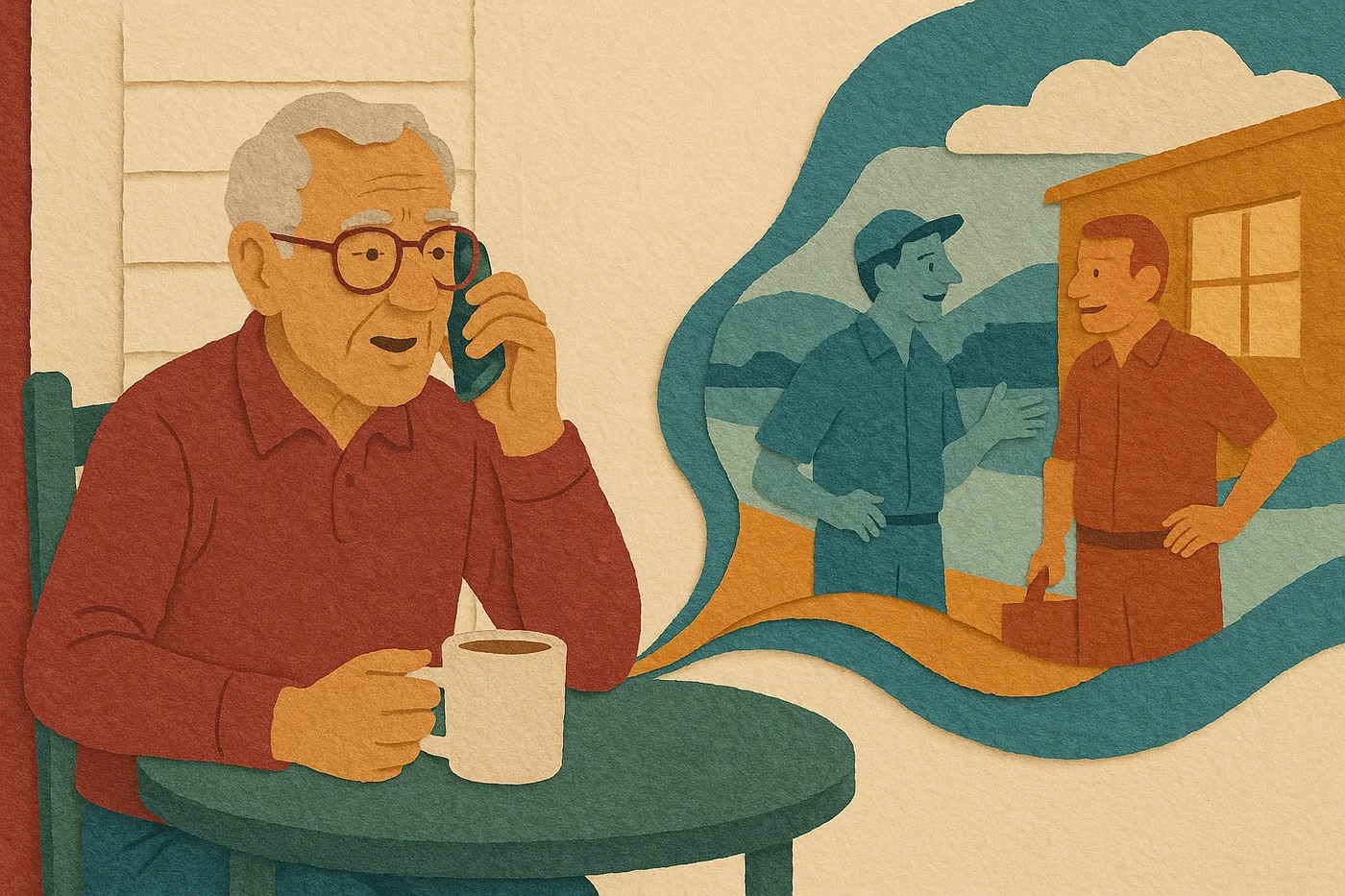
Ask three people in the same family to tell the story of the flood, the move, or the summer everyone got sick, and none of the three versions will match exactly. One remembers who drove. Another remembers what was on the radio. A third swears it happened a year earlier than it did. None of them is lying, and none of them is wrong in the way that matters.
Family storytelling is the practice of telling the same stories often enough, to enough different people, that they stop belonging to one teller and become something the whole family recognizes — even while the details keep shifting slightly with every retelling. The record a family actually keeps is not one clean version. It is the pattern across all the versions, variations included.
What family storytelling actually is, beyond "the stories we tell"
Most families already do this without naming it: the same handful of stories get told at holidays, in cars, at hospital bedsides, retold so often that a grandchild can finish the sentence before the grandparent gets there. What makes it storytelling rather than just information is repetition — a fact gets stated once, but a story gets performed again and again, and each performance is shaped a little by who is listening and what the room needs that day.
That repetition is not a flaw to correct. It is how the story survives. A detail that only gets said once is easy to lose. A detail that gets said fifteen times, even with small variations, is the one still standing when the person who lived it is gone.
Why the same story changes a little every time
The version told to a five-year-old grandchild leaves out the parts that need context. The version told at a funeral leans toward the tender parts. The version told to an old friend who was there gets sharper and more specific, because the audience can catch an inaccuracy. None of these is the "real" version with the others as approximations. They are the same story doing different jobs, and all of them are evidence.
This is also where families run into trouble trying to write things down. The instinct is to interview one person once, get "the" account, and treat it as settled. But a story captured on its first telling is often thinner than the fifth or sixth — missing the detail that only surfaces once someone else in the room says "wait, tell them about the dog" or corrects a date. Respectful capture means expecting the story to arrive in pieces over more than one conversation, not treating the first pass as final.
What gets lost when someone tries to fix the story into one version
Smoothing several accounts into a single official one is tempting, especially for anyone assembling a book or a timeline. It also throws away the most honest part of the record: where people disagree. Two siblings remembering the same argument differently is not a contradiction to resolve before publishing — it is information about how the event was actually experienced, by two different people, at two different ages, in two different roles in the family.
A better instinct is to keep the disagreement visible rather than picking a winner. "Mom remembers it happened in the kitchen; her brother remembers the porch" is a more honest sentence than a confident, invented consensus. The Oral History Association's published guidance on narrator review — letting the person being recorded see and correct their own account, rather than a third party quietly deciding which version is true — is built on the same principle: the person who lived it gets the final say over their own telling, not the person writing it down.
A respectful capture checklist
Before recording or writing down a family story, whether by hand or with any tool, these five questions keep the process from flattening what makes the story recognizable:
- Has this person told this story more than once? If so, ask what changed between tellings — that variation is part of the record, not noise to average out.
- Who else was there? A second account, even a partial one, catches details the first teller left out or forgot.
- Is a disagreement being resolved instead of recorded? If two accounts differ, write down both rather than picking the more confident one.
- Does the exact phrasing survive, or only the summary? "It was a hard winter" and the specific sentence someone actually used are not the same record.
- Was there a chance to correct the account afterward? A story is not finished the moment it is written down. The person who told it should see it again before anyone treats it as settled.
Where this leads
A family that starts paying attention to how a story gets retold, rather than just what it says, usually ends up wanting somewhere to keep the different versions together instead of losing the variation to one flattened draft. A family memory book should keep stories, not just answers makes the case for a format built around exactly that — follow-up, disagreement, and uncertainty included rather than edited out.
Joan is built around the same instinct: conversations paced over time instead of a single sitting, room for a story to come back changed on the third telling, and nothing entering the archive until the person who told it has approved how it reads.
If that is the kind of record your family is trying to keep, join Founding Families.