
Family stories
A Gift for Dad Who Has Everything: Ask for the Stories Behind the Facts
A gift for dad who has everything that works even when he isn't a talker — indirect questions that reach the stories behind the facts he already tells.
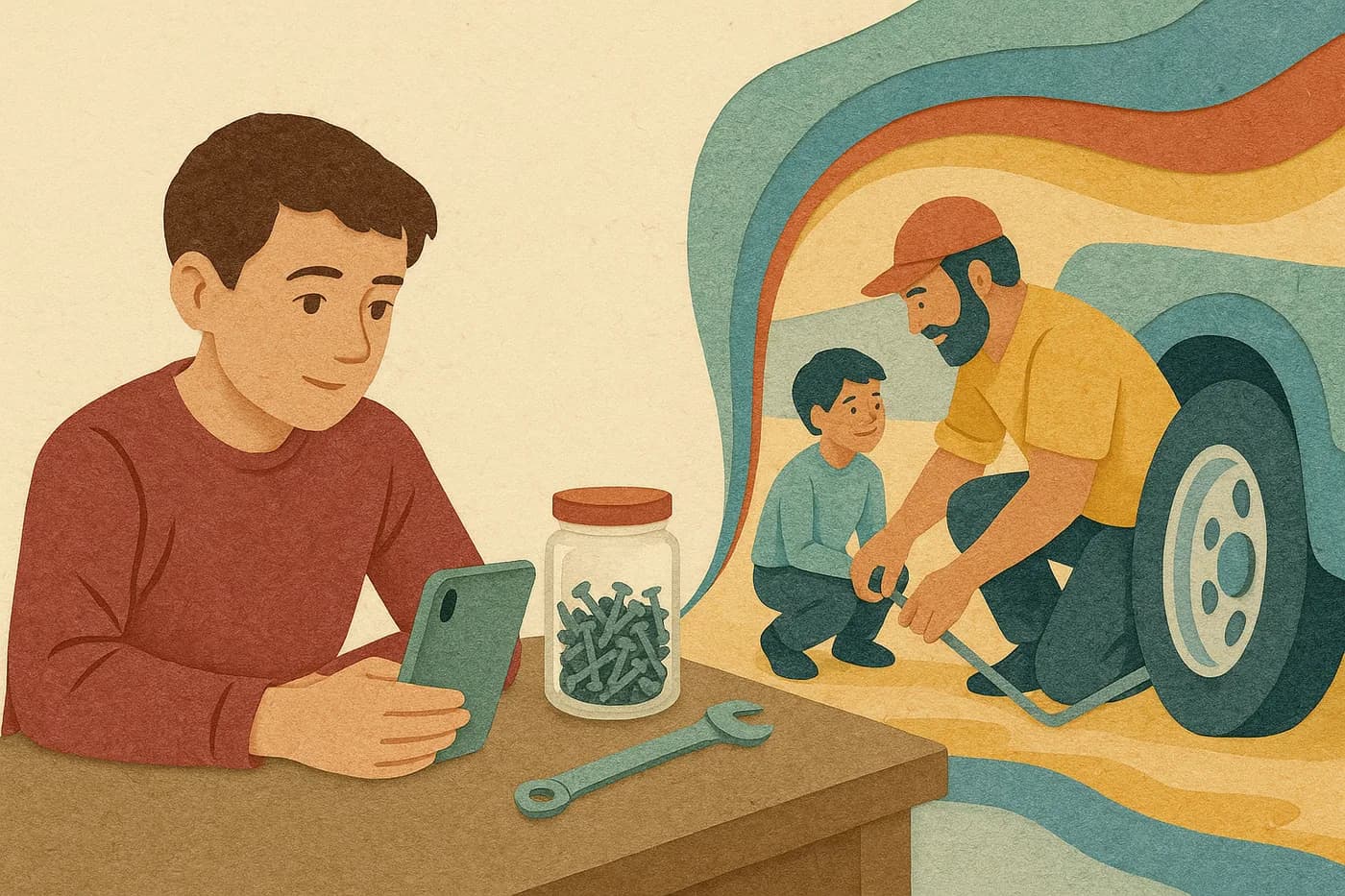
Dad already has a tool for every job, a chair he likes, and a drawer nobody else is allowed to reorganize. A gift for dad who has everything runs into a specific wall fast: even the things he doesn't own, he probably doesn't want. What he does have, and what nobody has actually asked him for, are the stories behind the facts everyone in the family already half-knows.
A gift for dad who has everything works best when it doesn't ask him to perform. Many fathers answer a direct "tell me about your life" with a shrug and a fact — where he was born, what year he started the job — because that's the register the question was asked in. The better gift asks around the fact instead of at it: what the job was actually like the first week, what he was thinking right before he proposed, why he still drives the long way home. Reserved storytellers open up to the side door more often than the front one.
Why "tell me about yourself" doesn't work on a lot of dads
Ask most fathers to talk about themselves and the answer comes back short — not because there's nothing there, but because the question is too open and too exposed. A lifetime of being the one who fixes things rather than the one who's asked about them doesn't reverse itself because someone hands over a notebook and says "write your story."
What tends to work instead is a specific, concrete question anchored to an object, a place, or a task: not "what was your childhood like" but "what was in your pockets on a normal school day." A question with a real, findable answer lowers the bar enough that a reserved storyteller will actually reach for it — and the specific answer he gives often opens onto the larger story on its own, without ever having to ask him to narrate his whole life at once.
Indirect ways into a story he wouldn't tell you directly
A few approaches tend to work on fathers who won't answer a direct emotional question but will answer almost anything adjacent to it.
Ask about the work, not the feeling. "What was the hardest part of that job" gets further than "were you happy back then." Fathers who deflect a feeling question will often walk through a process in detail — and the feeling comes out sideways, inside the description of the work.
Ask what he'd do differently with a tool, not with his life. "How would you have fixed that car if you'd had the parts you have now" is a question about mechanics on the surface. It's also a question about a version of events he's replayed for decades, and it tends to get a more honest answer than "any regrets."
Let an object start the conversation. A photo, a tool, a medal, a specific address — something he can hold or picture — gives a reserved talker somewhere to put his attention besides the person asking. The story arrives while he's looking at the thing, not at you.
Take the second answer, not the first. The first answer to almost any question a reserved father gets is the short, practiced one — the version he's given a hundred times because it's easy to give. The real detail tends to show up in the follow-up, once he's decided the first answer wasn't quite the whole thing. That only happens if there's room for a follow-up at all, which means resisting the urge to move to the next question the moment he stops talking.
What this looks like as an actual gift
In practice, this isn't a single sit-down interview — for a lot of fathers, an interview is exactly the format that shuts the door. It works better spread across ordinary moments that are already happening: a car ride, a task in the garage, a phone call that would have happened anyway. A few questions this visit, a few more next time, following whatever he brings up rather than working down a list.
It also means giving him a real way out of a question. A father who changes the subject, or answers with a joke instead of an answer, should get to do that without being pushed back toward the original question. Some material a father keeps to himself for reasons that have nothing to do with forgetting, and treating every deflection as a puzzle to solve turns the gift into pressure instead of an invitation.
None of this produces a verified, tidy account either. He may remember an event differently than his brother does, or tell it slightly differently than he did the last time it came up. A good process keeps that honestly, noting where the record is uncertain or where two people in the family disagree, rather than quietly settling on one version and calling it fact. That follows the Oral History Association's published guidance on narrator review — letting the person who told the story see and correct it before anyone treats it as final. None of this is a check on him. It's simply making room for what he chooses to say, on his own terms, at his own pace.
A short test before you commit to this gift
Whether you run this yourself or set up a process for him, check the idea against a few questions first:
- Does it ask around the story, or straight at it? A concrete question about a task, an object, or a decision usually beats a direct question about feelings — especially for someone who deflects the direct version.
- Is there an easy way for him to pass? If every question demands an answer, it will read as an interview, and a lot of fathers will simply stop participating.
- Does it survive more than one sitting? A single conversation gets the practiced version. The unexpected detail tends to show up on the third or fourth try, once the questions stop feeling like a test.
- Where does what he says actually go? A conversation nobody can return to later is a nice afternoon and nothing more. The record is what makes it a gift rather than an errand.
An approach that clears all four is worth pursuing. One that fails the first is probably still a decent way to spend time with him — just not this particular gift.
Where this can lead
Some families want a place for what he says to live afterward, next to the photos and whatever the family has already been keeping. A family memory book should keep stories, not just answers makes the case for what separates a book people actually reopen from one that gets filled in once and shelved. If dad is one of several parents you're choosing a gift for this year, a gift for parents who have everything sorts the wider range of non-object options by the job each one performs.
Joan is built for exactly this kind of reserved storyteller — a standing conversation paced over weeks, built around specific and indirect questions rather than a single sit-down interview, with nothing entering the archive until he has approved it. It's one honest option for a gift for dad who has everything, not the automatic answer for every father, and it's worth choosing only if a slow conversation on his own terms is actually the gift he'd want.
If that sounds like the right gift for your family, join Founding Families.