
The craft
How to Build a Memoir Outline You'll Actually Use
A memoir outline should decide structure, not summarize a life. Chronology-versus-theme decision rules, a four-part shape, and a copyable template.
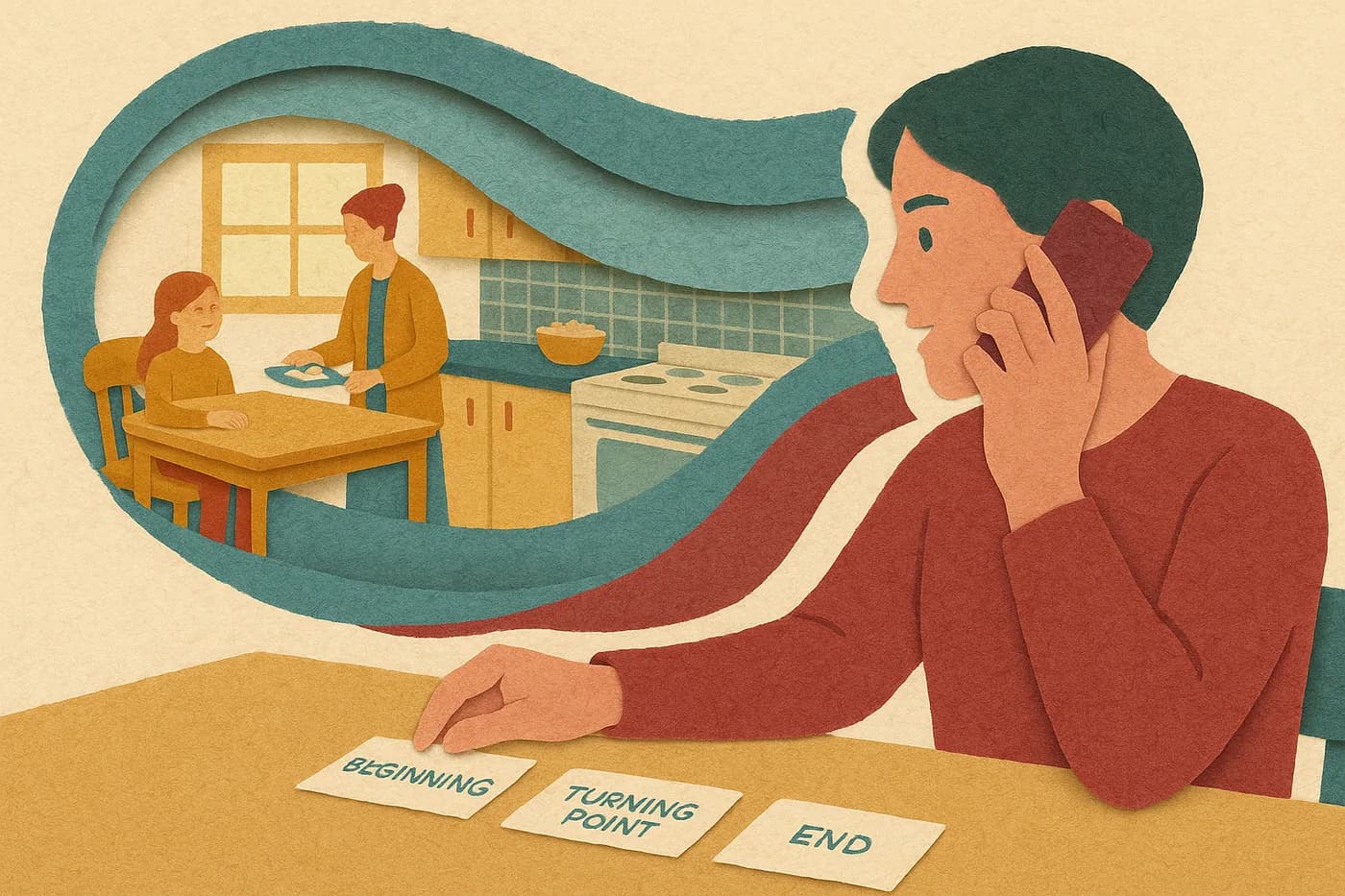
Most people who sit down to write a memoir outline try to summarize an entire life in order, and stall somewhere around age eleven. An outline that lists every year is a table of contents for a life, not a plan for a book — it tells you what happened, not what the book is actually about.
A memoir outline works better as a small set of structural decisions than a full timeline: which single thread the book follows, whether that thread runs by chronology or by theme, and which four or five scenes carry the real weight. Everything else — the years in between, the minor relatives, the jobs that didn't change anything — can be summarized in a sentence or left out, once the outline has decided what the book is actually for.
Chronology or theme: the first decision a memoir outline has to make
A chronological outline follows time: childhood, early adulthood, the decades after, roughly in the order they happened. It suits a life with one clear throughline — one career, one marriage, one place — where the order itself is part of the story. It also suits a reader who wants to follow the whole arc of a life, in something close to the order it was lived.
A thematic outline follows a subject instead of a clock: work, faith, a single relationship, a recurring choice the person kept making differently. Scenes from different decades sit next to each other because they answer the same question, not because they happened in sequence. This suits a life with several distinct chapters that don't connect chronologically — a person who changed countries, careers, or families more than once — where forcing one timeline flattens what actually mattered.
Most memoirs that stall aren't stuck on chronology or theme individually — they're stuck because nobody decided which one the book is following, so every scene has to justify its place twice: does it belong in the timeline, and does it belong to the theme. Pick one organizing principle before outlining scenes, and let the other stay in the background as a check, not a second structure to maintain.
A hybrid outline, for a life with more than one thread
Most real lives don't sort cleanly into "pure chronology" or "pure theme," and a memoir outline doesn't have to pretend otherwise. The most common working shape is a hybrid: a chronological spine — childhood, the middle years, later life, in that order — with individual chapters organized thematically inside each stretch of time. A chapter covering someone's thirties might gather every scene about work from that decade, then every scene about a marriage, rather than alternating between them in the order they happened that year.
The test for whether a hybrid outline is working is simple: can a reader always tell roughly when they are, even inside a themed chapter? If a chapter jumps between a person's twenties and sixties without warning, the outline needs a clearer marker — a date, a season, an age stated plainly — not a more complicated structure. A hybrid outline fails when it tries to be fully chronological and fully thematic in the same paragraph; it works when each level does one job.
The four-part shape most memoir outlines share
Underneath either organizing principle, most working memoirs share a smaller shape:
- An opening scene that already has stakes. Not the earliest chronological moment — the first moment worth reading. A memoir outline that opens with birth or a family tree is asking the reader to wait for the story to start.
- The expansion. The scenes and context that explain how the opening scene became possible — the people, the place, the ordinary conditions of that life before anything changed.
- The turn. A decision, loss, arrival, or realization that the rest of the book measures itself against. Most lives have more than one candidate for this; the outline only needs to pick the one the book is actually about.
- What the turn cost or revealed. Not a moral, and not a tidy lesson — what actually changed afterward, including what stayed unresolved.
A memoir outline can assign real scenes to each of these four slots before a single chapter is drafted, which turns "write my life story" into four smaller, answerable questions.
A memoir outline template you can copy
Use this to draft a first-pass outline before writing any chapter in full:
1. Organizing principle — chronology, theme, or a single relationship. Name it in one sentence.
2. Opening scene — place, time of day, who else is there, and what makes it worth starting here rather than earlier.
3. Three to five throughline scenes — for each: what happens, who is present, and what it would cost the book to cut it.
4. The turn — the one decision, loss, or change everything else is measured against. Name it in a sentence, not a paragraph.
5. What changed, and what didn't — the honest aftermath, including anything still unresolved.
6. Everything else — a single paragraph summarizing the years and relationships that support the throughline without needing their own scenes.
Fill in as much as you can in one sitting, in fragments rather than full sentences if that's what comes. The gaps you can't fill yet are often the more useful discovery than the parts you can.
What a memoir outline can't decide for you
An outline can organize scenes, but it can't settle whose account of a scene is correct. Family members who lived through the same period often remember the order, the words, or even who was present differently, and a memoir outline should leave room for that instead of forcing one version into a single timeline slot. A remembered account is not the same thing as a verified fact, and the strongest memoirs generally say so where it matters rather than quietly picking a winner.
The same caution applies to memory itself: an outline built entirely from what you can recall unprompted will have real gaps, and filling them with invented detail to make the timeline tidy is a different project than a memoir. Where a scene is genuinely uncertain, note it as uncertain in the outline and decide later — in the writing, not the planning — how much of that uncertainty belongs on the page.
Revising the outline once real chapters exist
An outline drafted before any chapter is written is a guess about what the book needs, and it should change once actual scenes exist to test it against. A scene that reads as flat on the page sometimes reveals that the outline put the turn in the wrong place, or that a "throughline scene" was really part of the expansion. Treat the outline as a working document you revise after every few chapters, not a contract you're stuck honoring — the version you draft on day one is a starting structure, not the finished shape of the book.
Where an outline runs into a bigger question
A memoir outline organizes scenes you already have. It doesn't help much with an earlier problem — finding the first scene at all when nothing comes to mind unprompted, or getting past the instinct to start at birth in the first place. How to start a memoir when chronology feels too large covers that earlier step directly, including a worksheet for finding a workable opening scene before you try to outline anything around it.
If the harder part isn't organizing scenes but getting someone to talk through them at all, the first conversation with Joan is free, with no card required.