
The craft
How to Write a Book About Your Life Without Writing Everything
A short framework for deciding who your book is for, what stretch of your life it covers, where its material comes from, and where it stops.
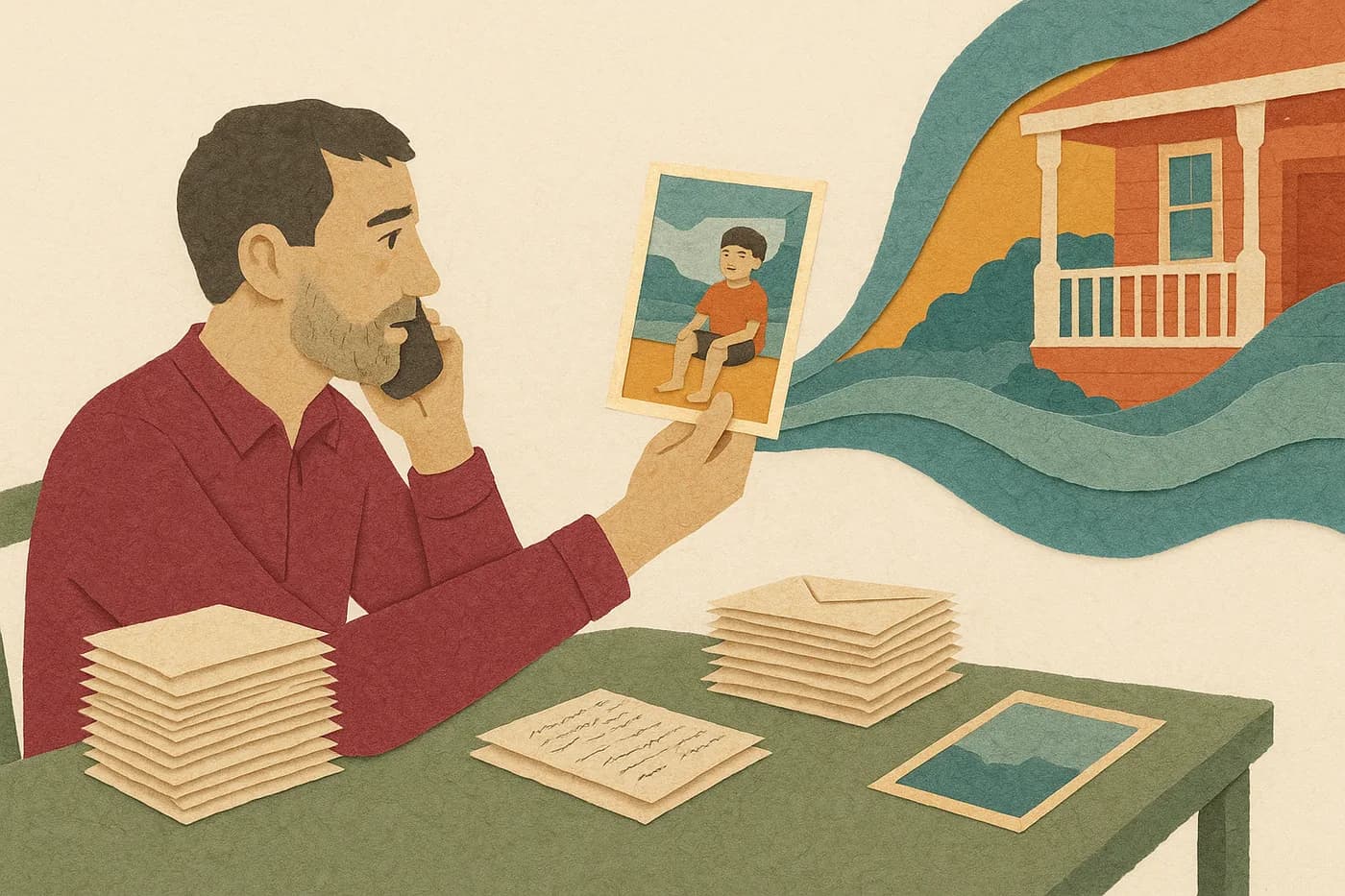
Most people who say they want to write a book about their life stall before the second page — not because they've forgotten anything, but because they're trying to hold the entire thing in one manuscript at once, and no shape emerges from "everything."
Writing a book about your life is really four separate decisions, not one long recollection: who the book is for, what stretch of your life it actually covers, where its material comes from, and where it stops. Settle those four before drafting a page, and the book gets a shape you can finish. Leave them open, and it stays an unbounded record you can only ever add to.
The problem isn't memory — it's an unset boundary
A life has no natural edges. It doesn't announce a first chapter or a last one, and almost nothing about it resolves itself the way a novel's plot does. So a writer who sits down to "write my life" is really being asked to invent a boundary from nothing, and most people postpone that decision instead of making it — which means every session starts by re-deciding what the book is even about.
The fix isn't more material. Most people who want to write about their life already have more than enough of it — memories, photographs, other people's accounts, documents. The fix is choosing, on purpose and in advance, which parts of that material this particular book will use, and treating everything else as material for a different book, or no book at all.
Decide who the book is for
The same set of memories produces a different manuscript depending on the reader. A book meant for your grandchildren in thirty years can leave a decade unexplained, because the people who lived through it already know the context. A book meant for readers outside the family needs to establish that context on the page — what a town was like, what a job involved, what a historical moment meant to the people living in it.
Naming the reader first also settles a second question by default: how much needs explaining. Write for people who were there, and a single sentence can carry a whole understood history. Write for people who weren't, and that same sentence needs the paragraph around it that makes it make sense.
How to write a book about your life without covering all of it
Once you know who the book is for, pick one throughline and let it be the whole book — not a summary of everything else. A throughline can be:
- A decade. The years you were raising young children, or the years you spent building a business, told in enough detail to actually show what those years were like.
- A place. A house, a neighborhood, a town you left — the book follows the place, and your life passes through it.
- A relationship. A marriage, a friendship, a rivalry with a sibling — everything else in the book exists only where it touches that relationship.
- A career or craft. The work itself, followed from apprentice to whatever you became, with the rest of your life present only as it shaped the work.
- A single passage. An illness, a move, a divorce, an immigration — one hinge your life turned on, examined closely rather than summarized in a paragraph.
Each of these produces a finishable book, because each one tells you what to leave out. A life told through "everything that happened to me" has no such filter, and that's exactly why it rarely gets past the first chapter.
Decide where the material comes from — and what happens when it disagrees
A life-story book usually draws on more than your own memory: photographs, letters, documents, and other people's recollections of the same events. Naming those sources as you write — not as a bibliography at the end, but beside each claim — makes the book more useful to the people who eventually read it, and more honest about what you actually know versus what you're reconstructing.
Other people's memories of shared events will sometimes contradict yours, and sometimes contradict each other. The instinct is to quietly pick the version that fits the story best. A better instinct, drawn from the practice oral historians use when working with remembered testimony, is to preserve the disagreement on the page rather than resolve it artificially: note that your sibling remembers the move happening the summer before, or that your mother told the story differently depending on the year she told it. A remembered account is not the same thing as a verified fact, and a book that treats the difference honestly reads as more trustworthy, not less finished.
Decide where the book stops
"Until now" is not a stopping point — it guarantees the book never actually ends, because the present keeps moving while you're trying to write about it. A workable stopping point is something that already happened: the day you retired, the year the family moved, the event that resolved the question the book has been asking. Pick a stopping point that already has an ending, and the book can have one too.
If the throughline is a relationship or a passage rather than a fixed period, the natural stopping point is usually the moment that relationship or passage was itself resolved or changed — not the present day, and not your own death, which is not a scene anyone can write from the inside.
A one-page scoping worksheet
Answer these four questions in a sentence each, before writing anything else. Keep the answers taped inside the front cover of a notebook, or at the top of the document, so a stalled session can be resolved by rereading them rather than by starting over.
- Reader. Who is this book for — people who were there, or people who weren't?
- Throughline. What one decade, place, relationship, career, or passage is this book actually about?
- Sources. Where does each part of the story come from — your memory, a document, someone else's account — and where do accounts disagree?
- Stopping point. What already-completed event or moment does this book end on?
A draft that keeps drifting is almost always missing an answer to one of these four, not missing material. Reread the worksheet before adding a new chapter, and the question is usually which of the four the new material actually belongs to — if the honest answer is none of them, it belongs to a different book.
When parts of your own life exist only in someone else's memory
Some of what belongs in a life-story book isn't fully available from memory alone — the years before you could remember, a parent's version of an event you were too young to understand, a relative's account of a decision no one explained to you at the time. Starting a memoir with one scene rather than the whole chronology helps with the blank page; it doesn't recover material that only exists in someone else's recollection.
That's the gap a recorded conversation closes. Founding Families is built around drawing out exactly that kind of material — the parts of a life story that were always going to require asking someone else, not just remembering harder.