
Conversations
Questions to Ask Parents About Their Childhood Beyond "What Was It Like?"
Seven specific angles that get further than 'what was it like' — rooms, routines, rules, sounds, fears, freedom, and family roles, with follow-ups for each.
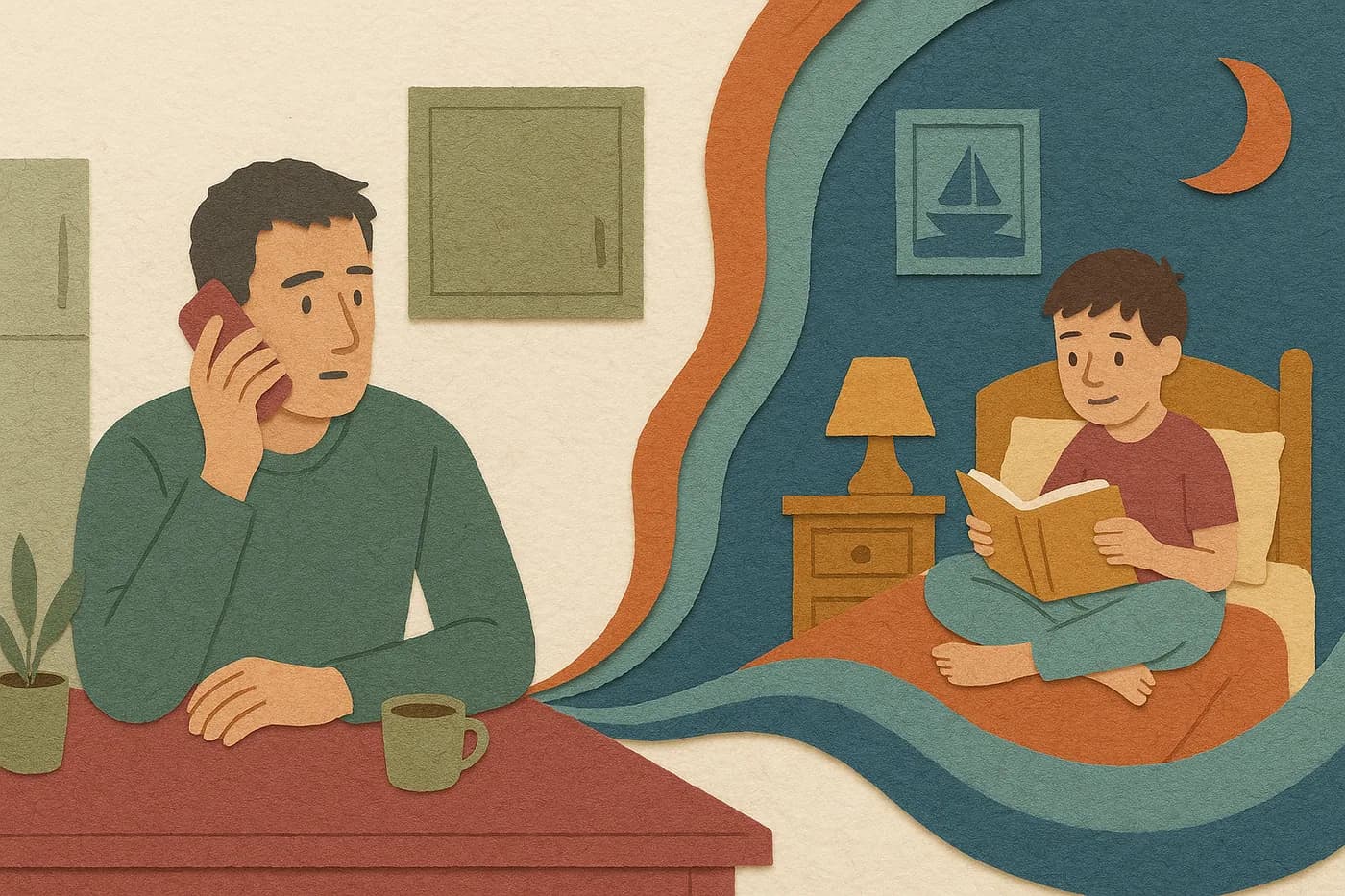
"What was your childhood like?" is the question almost everyone asks first, and it is also the one most likely to end the conversation before it starts. It hands back a decade to summarize, and a decade is too large a thing to hold at once — so the honest answer is usually a shrug dressed up as a sentence: pretty normal, I guess.
The questions that work better are smaller. Ask about parents' childhoods a room, a rule, a sound, or a fear at a time, rather than the whole span of it, and the specific answer arrives on its own — because a person retrieving one memory of a kitchen finds the radio, the argument about paint, and whoever else was standing in it, without ever being asked for any of that directly.
Why "what was it like" doesn't work
The question isn't wrong so much as too big to answer honestly in the moment. Faced with an entire childhood, most people reach for whatever version they've told before — the line that already exists, worn smooth from repetition. It isn't dishonest. It's just the only shape a decade can take when someone has three seconds to produce one.
Smaller questions change what's being asked for. "What did the kitchen look like when you were eight" doesn't require a verdict on an entire era of a person's life. It asks for one room, walked through once, and a room has edges a summary doesn't — a floor to start from, a window, whatever was on the stove.
Seven angles for questions to ask parents about their childhood
Rooms, routines, rules, sounds, fears, freedom, and family roles cover more of an actual childhood than any single "what was it like" ever will, because each one asks for something a person can walk into rather than something they have to judge from the outside.
A room. "What did your bedroom look like? Start with the door and describe what you'd see." A room holds objects, and objects hold people — the sister who wouldn't share the closet, the wallpaper nobody liked, whatever was hidden under the bed.
A routine. "What actually happened between getting home from school and dinner?" Routines are where the texture of a childhood lives — who was home, what was allowed, what the house sounded like at that hour.
A rule. "What was the one rule in your house that made no sense to you at the time?" Rules carry the parents who made them. This question usually returns a person, an era, and often an argument, in one answer.
A sound. "What's a sound you'd recognize instantly from that house, even now?" A slamming screen door, a particular record, a parent's key in the lock. Sound reaches memory in a way description doesn't, and it rarely comes with a rehearsed answer attached.
A fear. "What were you afraid of as a kid that nobody knew about?" Asked gently, this is one of the more revealing questions on the list — and one of the easiest to decline. Offer it, don't push it.
Freedom. "How far were you allowed to go on your own, and at what age?" This one maps an entire childhood in a single fact — the block, the town, the year that changed, and usually why.
A family role. "What job did you have in your family that nobody assigned you out loud?" The peacemaker, the one who noticed things, the one who got left in charge. Most people can answer this instantly, because they've never been asked.
Two or three of these in one conversation is enough. This is a set to choose from, not a script to complete in order.
The follow-up does more than the question
None of the seven questions above are the important part. What matters is what happens after the first answer — staying with a detail instead of moving to the next item, or asking "and then what happened" instead of "what else."
A parent who says "we weren't allowed past the corner" has handed over a fact. The follow-up — who decided that, and did you ever go past it anyway — is what turns the fact into a story. Most people stop one question short of the good part, because the fact feels like a complete answer and it technically is. It just isn't the interesting one.
This is difficult to do inside a family, and not for lack of curiosity. You already half-know the story, so you fill in the gap instead of asking about it. You've heard the version about the corner before, so you don't notice this telling adds a detail the last one didn't have. Joan's job is the part families rarely have room for: staying with one thread across more than one call, noticing what changed between two tellings of the same story, and coming back to something left unfinished — instead of moving on because the visit is almost over.
Some of this is theirs to decline
A fear, especially, is an invitation, not a form to fill out. If the answer is a redirect or a joke instead of a real one, that's the boundary being set in real time — accept it and move to a different angle rather than circling back to the same question later in the same conversation. The right to not answer is part of what makes the rest of it feel safe to answer.
This holds for the whole set. None of these questions are extraction tools, and a parent's silence on any of them is information, not a gap to be filled on the next call.
A printable path through the seven angles
Pick one row a day, or all seven across a few calls — not a single sitting.
| Angle | Ask | Good follow-up |
|---|---|---|
| A room | What did your bedroom look like? Start with the door. | Who else was in and out of that room? |
| A routine | What happened between school and dinner? | Was that the same every day, or did it change? |
| A rule | What rule made no sense to you at the time? | Did you ever find out why it existed? |
| A sound | What sound would you recognize instantly from that house? | Who else would have recognized it too? |
| A fear | What were you afraid of that nobody knew about? | Did you ever tell anyone, before now? |
| Freedom | How far were you allowed to go alone, and at what age? | What changed, and do you remember why? |
| A family role | What job did you have that nobody assigned out loud? | Who noticed you doing it? |
What to do with the answers
Write down what's said close to word for word where you can — the exact phrase someone uses for a rule or a fear is usually more telling than the fact underneath it, and it's the first thing a tidied-up retelling loses. If a sibling remembers the rule differently, keep both versions rather than deciding which one is correct. The Oral History Association's published guidance on narrator review — letting the person who told the story see and correct what was recorded, rather than treating a first telling as final — applies as well to a note taken after a phone call as it does to a formal interview.
None of this requires perfect recall on anyone's part. A remembered childhood is not a verified transcript, and two honest people can disagree about the same rule, the same year, the same room. That disagreement is worth keeping, not resolving in favor of whichever version sounds more certain.
For the wider version of this — questions that work across a parent's whole life, not just the years before you knew them — see Questions you'll wish you had asked your parents. And if a sit-down set of questions is more structure than your family wants right now, family conversation starters that don't feel like an interview cover the same ground at a dinner table instead.
Joan asks questions like these over a series of ordinary calls, staying with one thread at a time and leaving the ones that go quiet alone. If your family is ready for someone else to hold that pacing, join Founding Families.