
Conversations
8 Things Not to Say to Your Aging Parents — and What Opens a Story Instead
Eight common phrases that shut a conversation down without meaning to — and the specific, story-opening line to use instead of each one.
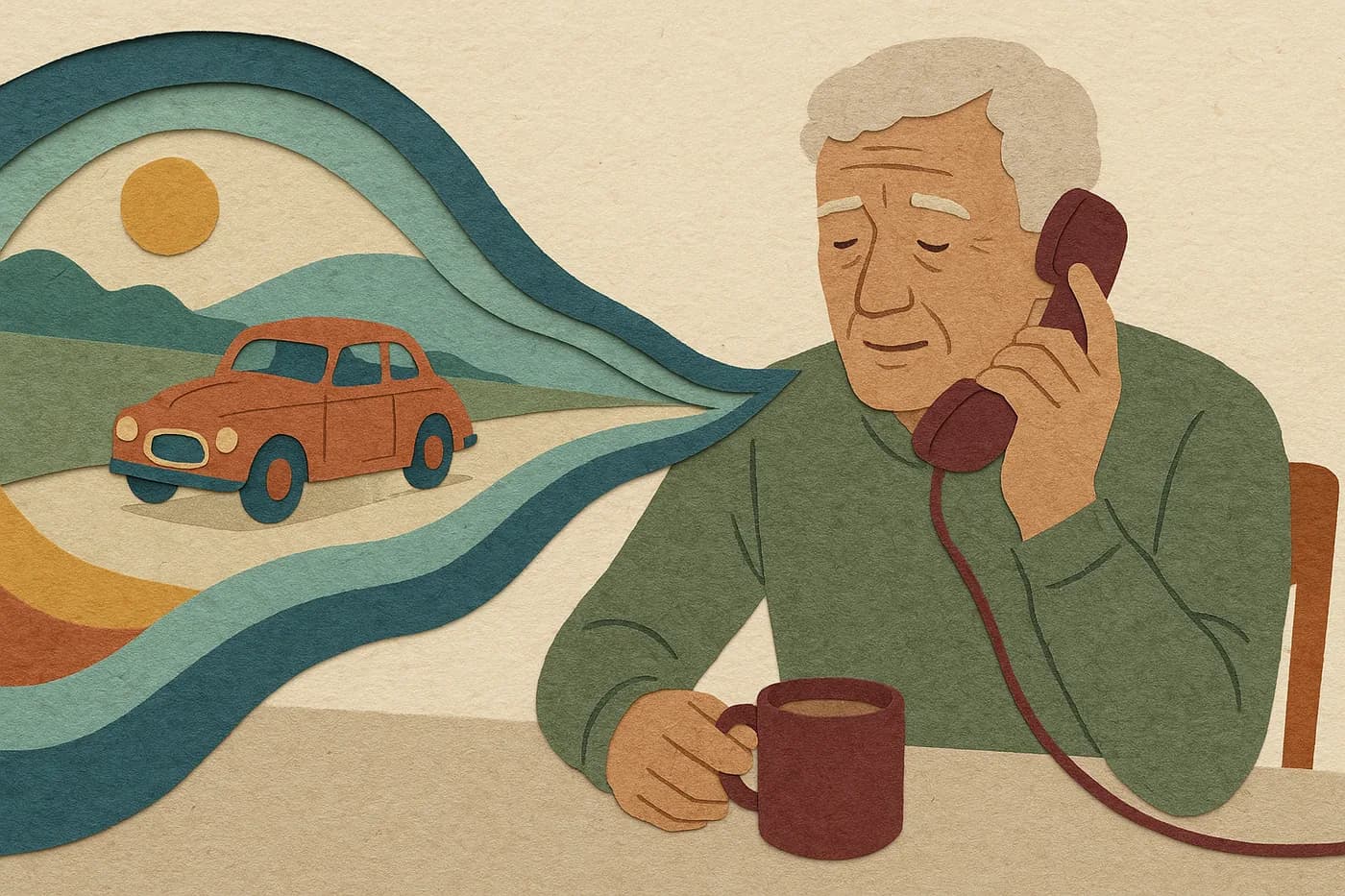
None of these phrases are said unkindly. They come out during a rushed visit, or over a worried phone call, usually from someone trying to help. But a parent hears them differently than they were meant — as a verdict on what they can still do, rather than a question about who they are.
The 8 things not to say to your aging parents share one problem: each treats a person as a situation to be managed rather than someone to ask about. Each has a close cousin that does the opposite — a specific question that hands the conversation back to them instead of taking it over. Swapping one for the other costs nothing and usually opens more than it closes.
The 8 things not to say to your aging parents
The pattern is easier to see side by side. The left column is what tends to get said; the right column is a specific alternative aimed at the same underlying worry, phrased as a question instead of a conclusion.
| Instead of this | Try this |
|---|---|
| "You need to start thinking about downsizing." | "What do you love about this house that a smaller place couldn't hold?" |
| "Are you sure you should still be driving?" | "What was the first car you ever drove, and how did you learn?" |
| "You're not as sharp as you used to be." | "What's something you used to know cold, that you've let yourself forget on purpose?" |
| "What do you want us to do with all this stuff?" | "If you had five minutes in this house, what's the one thing you'd grab?" |
| "Did you take your pills?" as the first thing said | "What's kept you busy today?" — then the practical questions, later |
| "You should really see someone about that." | "How does a normal day here actually go, hour by hour?" |
| "We need to talk about what happens when you can't live alone." | "What does a good day here look like to you right now?" |
| "Do you even remember [an old family story]?" | "Tell me your version of it — I want to hear it the way you remember it." |
None of the right-hand versions avoid the underlying subject. A parent who answers "what would you grab in five minutes" is still telling you what matters in that house. The difference is that they get to choose what to say, instead of defending a decision that was announced to them.
Why the left column lands badly
Three things are going on in most of these phrases, and none of them is really about vocabulary.
They treat a future decision as already made. "You need to start thinking about downsizing" isn't a question — it's a conclusion dressed as a suggestion, and most people can hear the difference. A parent who is asked what they'd protect from a fire is being consulted. A parent who is told what they need to start thinking about is being informed.
They lead with a task instead of a person. "Did you take your pills" as the first sentence of a visit sets the whole tone: this conversation exists to check on you, not to be with you. The logistics still need covering — they just don't have to go first.
They ask a person to prove something instead of tell something. "Do you even remember" and "are you sure you should still" are both tests, and most people, at any age, answer a test defensively. A specific, curious question — the first car, the exact hour-by-hour shape of a day — asks for a story instead of a grade.
Make the swap a habit, not a script
The eight lines above are not a checklist to memorize before a visit. The habit worth building is smaller: before saying something that sounds like a verdict, ask whether there's a specific question hiding behind it — and ask that instead.
"You should downsize" is usually standing in for "I'm worried about you managing this house alone." Said directly, or turned into a question about what the house holds for them, it does more than the flat statement ever could. The worry doesn't have to disappear from the conversation. It just doesn't have to arrive first, or alone.
Adjust for hearing, energy, and comfort — not for what you assume about their mind
If a question needs repeating, or an answer trails off, that's usually about hearing or stamina in the moment, not a reason to start reading meaning into it. Ask the harder or more open question when your parent is usually most alert, not whenever the visit happens to land. Sit where they can see your face. Stop before anyone is tired.
None of this is a diagnosis, and it isn't the routine's place to make one. A slow or short answer is information about the moment — a long day, a loud room, a question asked too late in the evening — not a data point to build a theory on.
When a subject stays closed, leave it closed that day
Some of the right-hand questions will get a short answer and a change of subject. That's a boundary being set, not a conversation that failed. The Oral History Association's published guidance on narrator consent is built around the same idea for formal interviews: the person telling the story decides what gets told and when, and a pause deserves the same respect as an answer.
Note that the door was there, and come back to it weeks later if it feels wanted — never in the same visit, and never with "why won't you talk about it."
Where to go from here
For the fuller set of questions this piece draws its alternatives from, Questions you'll wish you had asked your parents covers a parent's whole life, not just how to avoid one bad line. Questions to ask aging parents, without the checklist goes further into pacing a short visit so the story questions don't get squeezed out by the practical ones. And 35 questions to ask your parents is a free printable version, one question per call, with a follow-up written under each.
Joan is built around the same habit this piece describes: asking a specific question, listening to what comes back, and leaving a closed door alone rather than circling back to it mid-visit. If your family is ready for someone else to hold that pacing, join Founding Families.