
Conversations
Autobiography Interview Questions for Turning Memory Into Material
Autobiography interview questions in two paths — interviewer or self-interview — that trade a tidy summary for the scene, decision, or relationship it happened to.
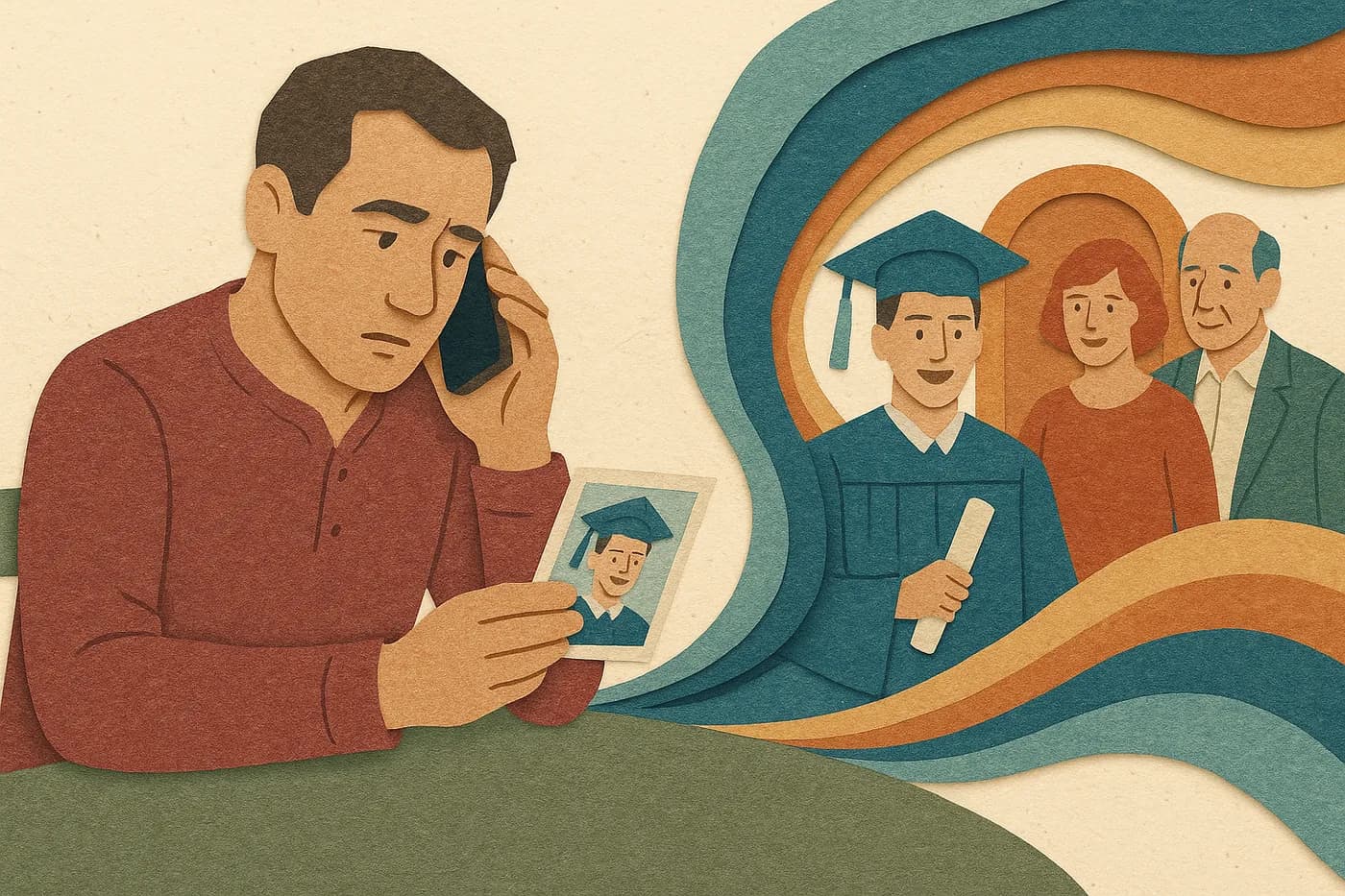
Most autobiography interview questions try to do two jobs at once: recover a memory and summarize it into a lesson. That double duty is why so many self-interview lists produce paragraphs that sound written for a stranger — general, tidy, and short on the detail that actually happened. A better question does one job first: it puts the person back in a specific afternoon, and lets the meaning follow if it wants to, not before.
Autobiography interview questions work best in two passes — one that recovers a scene (a room, a decision, a person) in concrete detail, and a second that asks what the scene meant, asked only once the detail exists. Whether someone else is asking or you are asking yourself, the same order applies: specific before general, and follow-up before the next item on the list.
Two ways to ask autobiography interview questions: as an interviewer or alone
Autobiography interview questions get used two different ways, and the difference matters more than the questions themselves. Someone might sit across from a parent, a grandparent, or a friend and ask them out loud — the questions serve as a guide, and the interviewer's job is mostly to listen and follow up on what actually comes back. Or someone might be answering their own questions, alone, writing toward a memoir or a life story with no one else in the room to notice when an answer is thin.
The self-interview path is harder in one specific way: there is no one else to catch a summary before it gets written down as if it were a scene. The fix is to build the follow-up into the method itself, rather than relying on it to arrive from someone else — write the first answer, then set the page aside and answer the same question again, this time naming one concrete detail the first pass left out.
Questions that recover a scene, not a summary
Start with the kind of question that is easy to answer in specifics, because it does not ask anyone to characterize a relationship or explain a decision yet.
- Where were you standing or sitting, and what was in your hands?
- What did the room, the street, or the car actually look like?
- What is one thing someone said, close to word for word, that you still remember?
These rarely produce the most striking material by themselves. Their job is to get the memory into a specific register — a place and a body in it — before asking what any of it meant.
Questions that recover a turning point or a decision
This is usually where the strongest material lives, and it works better once a few scene questions have already warmed up the memory.
- What decision changed the direction of things, and what did the alternative look like at the time?
- What did you know was ending before anyone said so out loud?
- What is something you did that surprised the people who knew you?
Turning-point questions ask for the moment before the outcome was obvious — the version of the story where it could still have gone another way.
Questions that recover a relationship, not a role
"My mother" or "my best friend" is a role. A question about one specific day with that person asks for the relationship instead.
- Tell me about a specific day with this person — not what they were like in general.
- Who did you go to when something was wrong, and why that person and not someone else?
- Whose version of a disagreement have you never told?
These can surface old tension alongside the warmth. That is not a reason to skip them; an account that only records agreement is not more accurate for leaving the friction out.
Ask yourself the follow-up when no one else will
A written list of autobiography interview questions is a starting point, whoever is asking. When someone else is interviewing, the strongest material usually comes from the question nobody wrote down in advance — the follow-up prompted by a name or a detail mentioned in passing. Writing alone loses that instinct, so it has to be replaced with a habit.
The two-pass method does that: answer a question once, in whatever comes out first — this draft is usually a summary. Then set it aside, come back later, and answer the same question again, this time with a rule attached: name one object, one piece of dialogue, or one sensory detail the first draft didn't include. Reading the first pass out loud, as if explaining it to someone who wasn't there, usually shows exactly where it went vague — that is where the second pass should start.
Consent, pacing, and the right not to answer
When these questions get used on someone else, they are an invitation, not an extraction tool. A person being interviewed for their autobiography or life story gets to skip a question without explaining why, and a good interviewer treats silence as an answer worth respecting rather than something to push past. The Oral History Association's published practices treat informed consent — knowing how a recording or a written account will be used and shared, and being able to set limits on it — as the start of an interview, not a formality attached afterward. The same courtesy applies to a self-interview: a question that surfaces something you don't want on the page yet can simply wait for a later draft.
A printable version of this question path
Print or copy this list before a session, interviewer or alone, in this order: two scene questions, one turning-point question, one relationship question, and — only in a second sitting — a second pass on whichever answer felt thinnest, using the two-pass method above. Leave space beside each question for the follow-up that the actual answer suggests, rather than moving straight to the next item on the list.
Where these questions lead
This path shares its shape with oral history interview questions that open a real conversation, which covers pacing, follow-up, and the right not to answer in more depth for anyone interviewing a family member rather than writing alone. For a different starting point into the same material, life story interview questions organized by the shape of a life moves through place, choice, and meaning in a longer arc.
If you'd rather someone else hold the questions and the pacing, join Founding Families.