
Conversations
Questions to Ask Veterans About Their Service Without Assuming the Story
A consent-first path of questions to ask veterans about their service, paced by what they choose to open — with real room for the parts they'd rather keep.
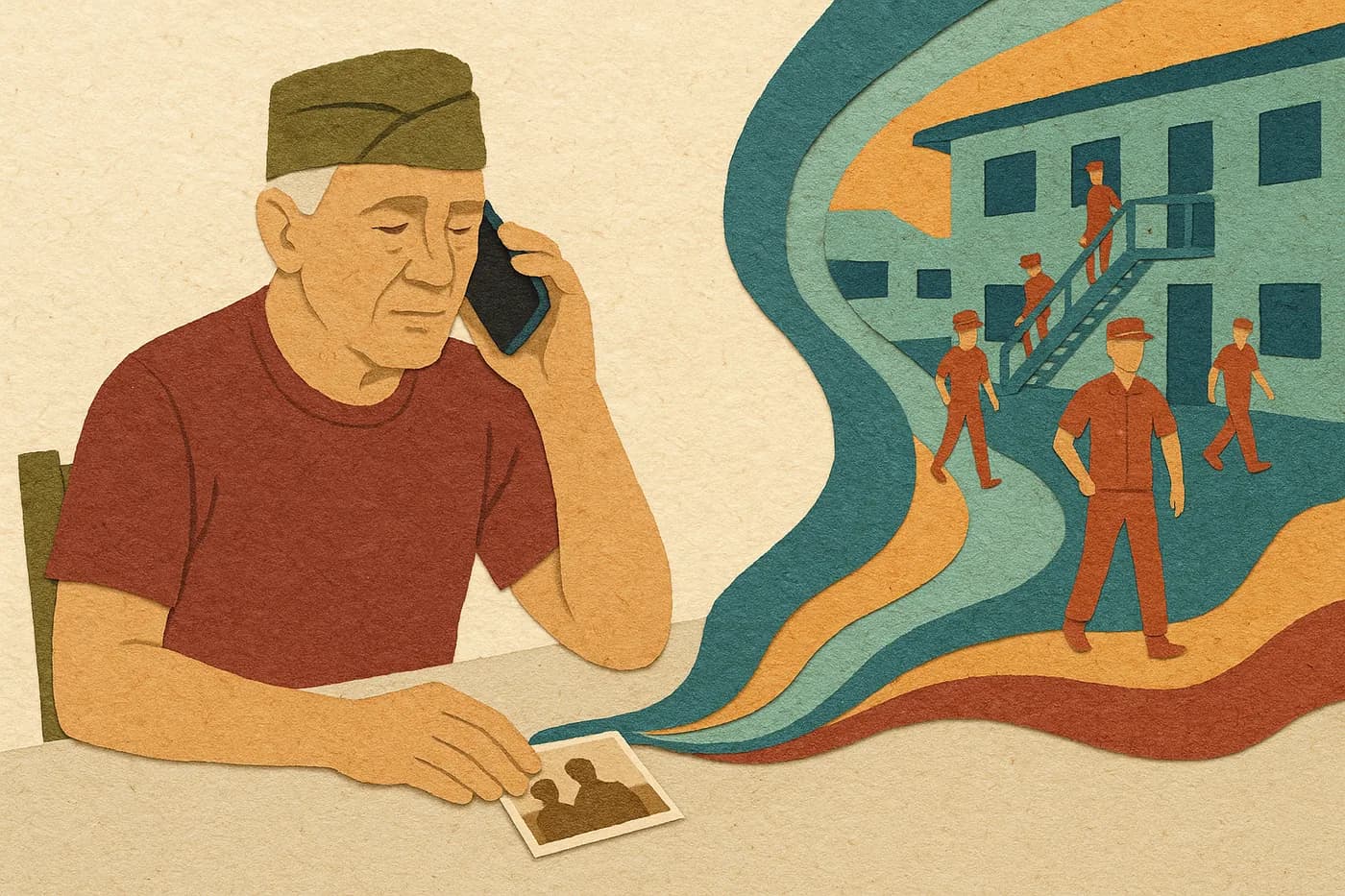
Ask "what was your service like" and you can get a shrug, a joke, or a single flat sentence that closes the door. The question is too big, and it usually carries an assumption underneath it — that there was danger, or loss, or a story owed to whoever is asking. Some veterans have that story. Many spent their time somewhere else entirely: a supply depot, a classroom, a ship that never saw action, a desk.
Questions to ask veterans about their service work better when they name something small and concrete — a job, a place, a person — instead of reaching for the whole subject at once. Ask what someone is willing to talk about before asking what happened. Let a short answer stand as a complete answer, not a prompt to push further, and go in expecting that some parts of the story are staying exactly where they are.
A few questions to ask veterans about their service, organized by what they open
Start with the ordinary shape of the time, not its most dramatic possible content.
Before
What sent someone in — a choice, a draft notice, a family expectation — says as much about the era as it does about them.
- What was going on in your life right before you went in?
- Did you choose your branch, or did it choose you?
- What did your family think at the time?
- Was there someone who tried to talk you out of it, or into it?
The ordinary parts of service
Most of a service member's time is not the part that makes a documentary. It is usually the part nobody has asked about.
- What was a normal day like, wherever you were stationed?
- What did you actually do — not the job title, the task itself?
- What did people do to pass the time when nothing was happening?
- What did you miss most from home, and what did you eventually stop missing?
People
- Who did you serve with that you still think about?
- Was there someone in your unit everyone counted on?
- Who did you lose touch with that you wish you hadn't?
- Is there someone from that time the rest of us have never heard about?
Coming home
- What was the first week back actually like?
- What did people get wrong about what you'd been through?
- What took the longest to feel ordinary again?
- Is there something you wish someone had asked you, and never did?
Notice there is no question here about combat. That is deliberate, not an oversight. Plenty of veterans never saw it, and for those who did, it is not owed on request. If it comes up, it should come up because the person chose to bring it there — not because a list of questions required it.
Ask before you ask
Before working through any of the above, ask about branch and era plainly rather than guessing from someone's age or assuming a particular war. Then ask a second, plainer question: "Is there anything about your time in the service you'd rather I didn't ask about?" That is a real question, not a courtesy, and an honest answer to it might rule out a whole section above before the conversation starts. Asking it also tells the person that the rest of the conversation is theirs to steer, which tends to open more than it closes.
Pace it, and let the boundaries hold
A short answer followed by a change of subject is not a failed question — it is the boundary being set in real time, and it deserves to be respected in that same conversation, not tested again five minutes later. The best follow-up is rarely a new question; it is "what happened next," or just a longer pause than feels comfortable, held until the person decides whether to fill it.
This is a conversation, not an evaluation, so there is no reason to assume distress where someone hasn't shown any, and no reason to offer advice about what they should be feeling. Adapt to what the person actually wants to say, not to an idea of what their service must have involved. If a question needs repeating because it wasn't heard, that is worth treating as a hearing issue and nothing more. Stop a session before anyone is tired, not after — a second conversation next week will get more than an extra twenty minutes squeezed out of a tired one.
What to do with the answers
A remembered account of a deployment, a unit, or a date is not the same thing as an official record, and a good record keeps that distinction instead of quietly smoothing it over. Memory compresses years into a handful of scenes, and two people who served side by side will sometimes describe the same stretch of time differently. Write down both versions rather than picking whichever sounds more certain.
The Oral History Association's published guidance is built for exactly this kind of material: informed consent given freely and revisited rather than assumed once and forgotten, narrator review that lets the person hear or read back what was recorded and correct it before it's treated as final, and access restrictions the narrator sets themselves — some accounts are for the family archive only, not for wider sharing, and that limit is part of the record, not a gap in it.
For the version of this built around grandparents in general, Questions to ask your grandparents that invite stories, not one-word answers covers the same pacing and follow-up in more ordinary territory. And the flexible path in Oral history interview questions that open a real conversation is worth borrowing directly — it moves from safe ground toward harder territory the same way this one does, in either order the conversation actually needs.
Joan asks questions like these over time, in ordinary phone conversations, following what a person actually says instead of moving down a fixed list — and never treating a closed door as something to reopen without being invited back. If your family is ready for someone else to hold that pacing, join Founding Families.