
The archive
What Makes an Oral History Archive Usable Decades Later?
An oral history archive stays usable for grandchildren only if recordings, transcripts, provenance, and permissions are captured on purpose, not left to chance.
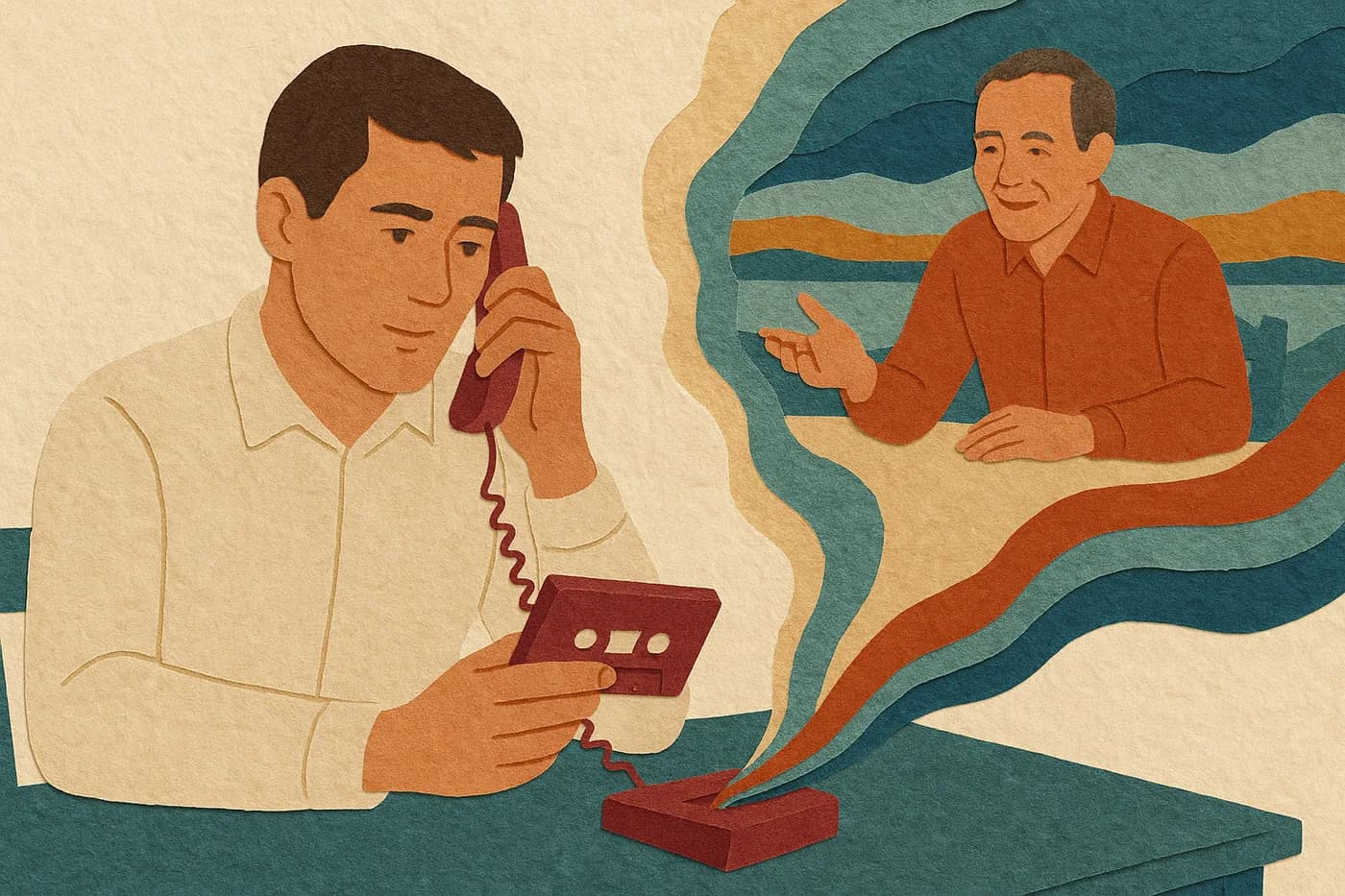
Most family recordings that survive physically don't survive usefully. A shoebox of cassette tapes, a folder of voice memos on a phone nobody uses anymore, a video file with a name like IMG_4471.mov — the audio is intact, but nobody remaining can say who's speaking, when it was recorded, or what was happening around it. The recording exists. The archive doesn't.
An oral history archive is usable decades later when four things are captured alongside the recording itself, not reconstructed afterward by someone guessing: who is speaking and their relationship to the family, when and where the conversation happened, what permission the person gave for how it could be used, and a transcript that preserves uncertainty instead of smoothing it into confident prose. Skip any of the four and the recording becomes a file a future relative can play but not really use.
Why the recording alone isn't the archive
A recording captures a voice. It doesn't capture who's listening to it, why the conversation happened, or what the storyteller expected to happen with it afterward. Thirty years on, a grandchild who finds a tape gets sound without context — a voice they may not even recognize, saying things they can't place in time or verify against anything else.
This is the gap between a recording and an archive. A recording is raw material. An archive is the recording plus everything that lets a person who wasn't there make sense of it: who's speaking, what they agreed to, and some record of what's fact, what's memory, and what's uncertain. The Oral History Association's published standards treat this pairing — recording plus documentation — as the baseline for a usable interview, not an optional extra layer added later if there's time.
The four things an archive needs beyond the audio
| Element | What it captures | Why it decays without it |
|---|---|---|
| Provenance | Who is speaking, their relationship to the family, and who conducted the conversation | A voice without a name becomes unidentifiable within one generation |
| Transcript | What was said, including hedges, corrections, and disagreement | Audio degrades and formats age out; text is what actually gets read |
| Permissions | What the storyteller agreed to — who can hear it, whether it can be quoted, whether it can be shared outside the family | Without a record of consent, a family either over-restricts a story out of caution or shares something the storyteller never agreed to |
| Durable format | A plain, non-proprietary format for both audio and transcript | A file only one app can open is unreadable once that app is gone |
Each one degrades on a different timeline, which is part of why they're easy to lose separately. A recording can outlast the memory of who's on it by decades. A transcript can outlast the recording if the original file gets corrupted. Permissions are the one piece that has no independent existence at all — if nobody wrote down what a storyteller agreed to, that consent is gone the moment the storyteller is.
Provenance: the difference between a voice and a person
"Provenance" sounds like an archival term because it is one, but the idea is ordinary: for every recording, note who's speaking, their relationship to the person building the archive, roughly when the conversation happened, and who else was in the room. That's it. It takes one sentence, written at the time, and it's the single note most family recordings are missing.
The cost of skipping it isn't obvious immediately, because the person recording still remembers everything. It shows up a generation later, when someone finds the file and has no way to confirm the voice is who they think it is, or when two similar recordings from the same year get confused with each other. Provenance is cheap to capture in the moment and expensive to reconstruct after.
Transcripts that keep the uncertainty in
A transcript is not just a text copy of the audio — it's a decision about how much of the person's actual speech to keep. A transcript that cleans up every hesitation, resolves every "I think it was maybe 1962, or was it '63," and smooths contradictions into one tidy account is easier to read and less honest. A remembered account is not the same thing as a verified fact, and a transcript is the place that distinction has to survive.
Keep three things a polished transcript tends to remove: hedges ("I think," "as far as I remember"), corrections the storyteller makes mid-answer, and any point where two people's accounts of the same event genuinely disagree. None of that is noise. It's the part of the record that tells a future reader how much weight to put on any given claim — the same discipline behind how to organize old family photos before nobody knows who is in them, which treats a caption's confidence level as real information, not a hedge to be edited away.
Permissions: the piece that can't be reconstructed
Every recorded conversation carries some understanding, explicit or not, about who gets to hear it and what can be done with it. A storyteller might be entirely comfortable with grandchildren hearing a story and firmly against it being shared outside the family, or fine with a written version but not the audio itself, or willing to discuss something once but not have it asked about again. None of that survives unless someone writes it down at the time.
This is the one archive element that genuinely can't be recovered later. A recording can be re-transcribed. A rough provenance note can sometimes be reconstructed from context. A permission that was never asked for and never recorded is simply unknown, and a family is left guessing — either restricting a story more than the person would have wanted, or sharing something they wouldn't have agreed to. Nothing enters the archive without approval goes deeper on why that approval step has to happen before a story is treated as settled, not after.
Durable format: usable by whoever comes next
The most common way a family archive quietly stops working is format decay: a voicemail app that's discontinued, a video format a phone no longer plays, a document only readable in software nobody has installed anymore. None of that requires anything dramatic to happen — it just requires ten or twenty years and no one checking.
The fix doesn't need to be technical. Keep the transcript as plain text or PDF rather than locked inside one app's proprietary export. Keep the audio in a widely supported, non-proprietary format rather than whatever the recording device defaulted to. And keep at least one copy somewhere other than the single device it was first recorded on — a second location matters more than a particular piece of software, because the risk that sinks most family archives isn't corruption, it's a device that gets replaced, lost, or simply not backed up.
A short audit for an archive you already have
If recordings already exist somewhere in the family, this takes about the same time per recording as it took to make it:
- Does every recording have a note of who's speaking and their relationship to the family?
- Is there a rough date and location for when the conversation happened?
- Does a transcript exist, and does it keep hedges and disagreements rather than smoothing them out?
- Is there any record — even a remembered one, written down now — of what the storyteller was comfortable having shared, and with whom?
- Is the audio in a common format, not one specific app's proprietary file type?
- Does a copy exist somewhere other than the original recording device?
A recording that fails several of these isn't wasted. It's still worth keeping, and worth going back to add what's missing while the people who remember the context are still around to supply it. The gap only becomes permanent once nobody's left who can answer the first two questions on that list.
What this doesn't solve
None of this turns a recording into something more than what was actually said. It won't recover a conversation nobody had, and it won't resolve which version of a disputed memory is true — some things stay genuinely uncertain, and an honest archive says so rather than picking a winner. The archive is the product, not the book makes the broader case for treating this underlying record — recordings, transcripts, and the documentation around them — as the lasting asset, with any printed or edited version as one export of it rather than the only copy.
Joan is built around keeping that record from the start: paced conversations, original recordings kept alongside their transcripts, and nothing entered into the archive until the storyteller has approved it. If your family wants that structure applied from the first conversation rather than reconstructed later, Founding Families is where that starts.