
The craft
Memoir Prompts for Seniors That Begin With Ordinary Life
Memoir prompts for seniors work best when they start with a Tuesday, not a decade — three entry points and the pacing that actually needs adjusting.
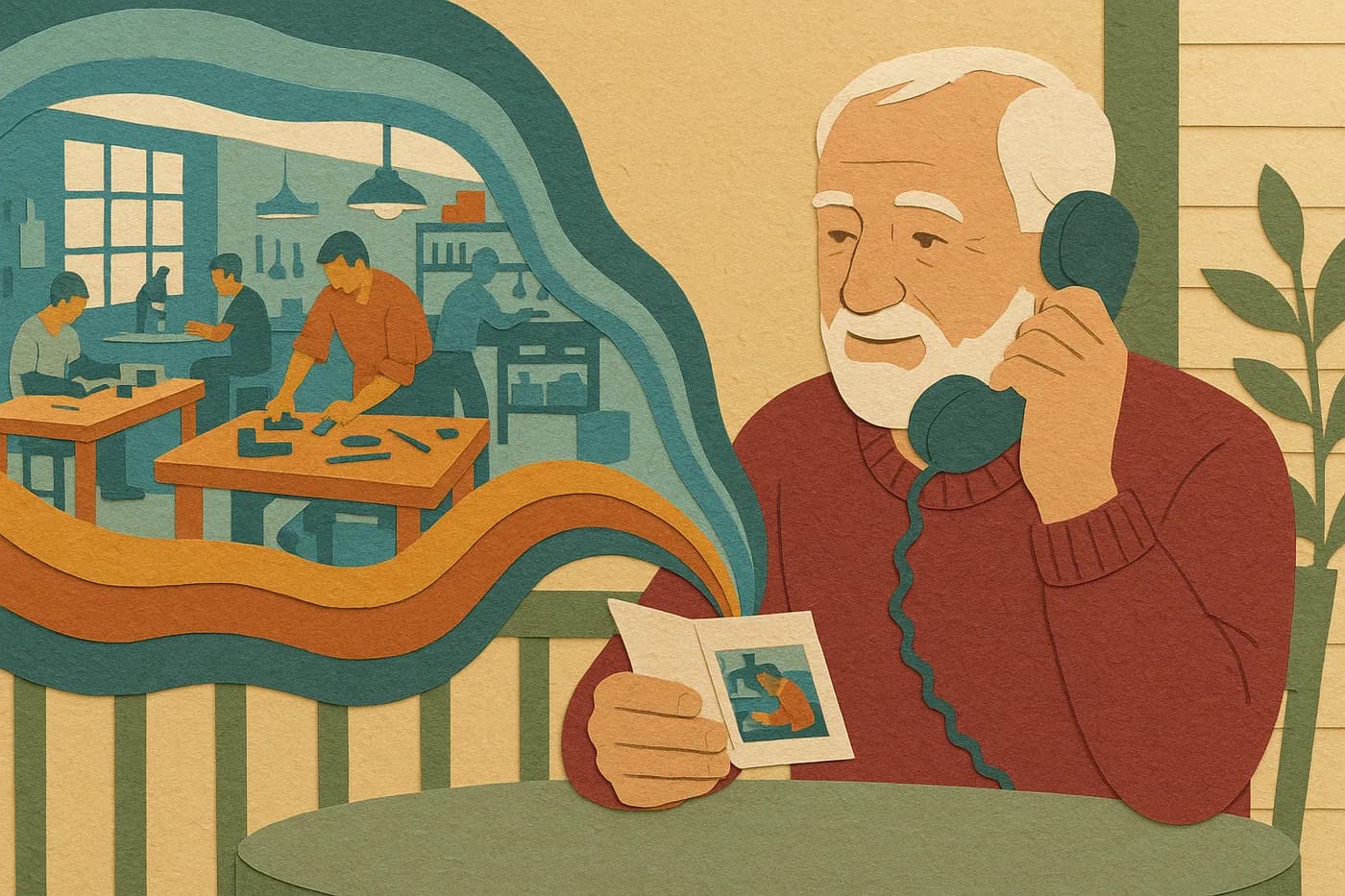
Most memoir prompts written specifically "for seniors" quietly assume the interesting part of a long life is the most recent decade of it — the grandchildren, the retirement, the health updates. The prompts that actually work do the opposite: they reach for a Tuesday from forty or sixty years ago and let the person's age be irrelevant to the question itself.
The direct answer: memoir prompts for seniors work best when they drop every senior-specific assumption and ask about a routine, a place, or a choice the same way they'd ask anyone — then adjust only the pacing, not the questions, for hearing, energy, and how long a single sitting should run. What follows is organized around three entry points — routine, place, and choice — plus the pacing adjustments that actually matter.
Why memoir prompts for seniors start in the wrong place
A prompt list built around the word "senior" tends to import a set of assumptions a long life doesn't need: that the story worth telling is recent, that the person's memory needs testing rather than inviting, or that a pause in the middle of an answer means something is wrong. None of that is a question about aging — it's a question about a life, and a life spanning eight or nine decades has more ordinary Tuesdays in it than anyone could get to in a single conversation.
The fix isn't a gentler version of the same list. It's a different set of entry points that work at any age and simply give a long life more material to work with.
Three entry points: a routine, a place, and a choice
A routine. What did an ordinary workday actually involve, hour to hour, in a specific year? Not "what was your job" — what time did it start, what did lunch look like, who else was on the shift, and what did the work smell or sound like from the inside?
A place. What is one thing about a house or a street they lived on that nobody would know just from a photograph of it? Who else lived there, and where did each person actually spend their time?
A choice. What is a decision that surprised the people around them at the time? What did the alternative look like, and who did they talk to before deciding, if anyone?
Each entry point works better as two or three follow-ups on the same subject than as a single question moving to the next unrelated one. A person asked "what did you do for work" will often answer with a title. A person asked what the shift actually involved, hour to hour, tends to answer with a scene.
Adjust the pacing, not the questions
The part that genuinely needs to change for an older storyteller isn't the question — it's the sitting. Shorter sessions, one entry point per visit rather than all three, and following the person's energy rather than a fixed clock all make more difference than any rewording of the prompt. If hearing makes back-and-forth conversation tiring, write the prompt down and let them read it before answering out loud.
None of this is a diagnosis to watch for. If a memory arrives in pieces, or a detail shifts between two tellings of the same story, that's how memory ordinarily works across any age — not a sign of decline, and not something to correct on the spot. A remembered account is not a verified fact, and it doesn't need to be one to be worth keeping. Preserve the disagreement rather than smoothing it into a single tidy version.
The right to skip a prompt
Every prompt here is an invitation, not a form to complete. A thread should stop the moment the person wants it to — a decision they'd rather not revisit, a place they'd rather not describe in detail. That's a complete answer, not an unfinished one. There will usually be another entry point into the same period of a life later, through a different routine, place, or choice entirely.
A printable prompt sheet
Write the three entry points across the top of a page — routine, place, choice — with the core question underneath each and a blank line labeled "follow-up" beneath it, as a reminder to write down whatever the person adds after the first answer rather than only the first answer itself. Work through one entry point per sitting. A sitting that tries to cover all three in one visit tends to produce the same fact-sized answers a generic checklist does.
Where these prompts connect
These three entry points are a narrower, senior-focused version of the same idea behind memoir prompts that lead somewhere better than a blank page — ask in threads, not single questions, and let the follow-up do the real work. The pacing guidance here pairs with questions to ask aging parents without turning the visit into an assignment, which covers adapting to hearing, energy, and comfort in more detail.
If your family would rather have someone hold these threads across an entire life than manage the list and the follow-up yourselves, join Founding Families.