
The archive
A Family History Scrapbook That Records Who, When, Where, and How We Know
A family history scrapbook can look beautiful and still lose the story without a light provenance system that survives being reopened decades later.
Most family history scrapbook advice covers one half of the job well. Craft guides explain paper, layout, and how to arrange a page so it's a pleasure to open. Genealogy guides explain how to cite a source so a fact holds up. Almost nothing covers both at once — which is how a genuinely beautiful scrapbook ends up, a decade later, full of pages nobody can explain.
A family history scrapbook that still means something later needs two things happening on every page: a layout built around real ephemera rather than only photographs, and a lightweight, unobtrusive way to record what each item is, where it came from, who kept it, and how sure anyone is. Skip the first and the book looks like a filing system. Skip the second and it becomes a lovely object full of unlabeled mysteries.
Why a beautiful page can still lose the story
A scrapbook page succeeds visually the moment it looks finished — torn edges lined up, colors that work together, a ticket stub angled just so under a photograph. None of that tells a future reader what the ticket was for, whose handwriting is on the letter tucked beside it, or why this particular arrangement of objects belongs together instead of scattered across three other pages. Visual coherence and factual coherence are different achievements, and a page can have one without the other.
The failure is quiet because it doesn't show up right away. The person who built the page still remembers every detail — where the letter came from, why the recipe card matters, whose ring that is in the corner photo. The gap only opens once that person is no longer the one turning the pages, and by then there's no one left to ask.
What a family history scrapbook can hold that a photo book can't
A photo book is built almost entirely from one kind of material: photographs, captioned. How to build a family history photo book people actually read covers what a strong caption needs — who, roughly when, how sure anyone is, and what happened just outside the frame. A family history scrapbook is a wider container. It can hold a letter, a ticket stub, a recipe card in someone's own handwriting, a pressed flower, a child's drawing, a folded telegram — objects that were never going to fit a photo book's format but that carry as much of the story as any picture does, sometimes more, because handwriting and an object's wear are themselves a kind of evidence a photograph can't replicate.
That range is the scrapbook's real advantage over a photo-only format. It's also what makes the provenance problem harder: a photo at least identifies itself as a photo. A ticket stub, out of context, identifies nothing.
A provenance system that doesn't wreck the page
The instinct once the provenance problem is visible is to write everything directly on the page — captions crowding every margin, explanations competing with the layout for space. That solves the memory problem and creates a new one: a scrapbook page covered in explanatory text stops being something anyone wants to look at, which defeats the reason to build a scrapbook instead of a plain archive folder in the first place.
The better split keeps the page itself uncluttered and moves the explanation one layer back. Give each page a short number or letter, written small in a corner or on the back. Keep a single companion sheet — one page, one notebook, or one running document — where that number points to an entry recording what's on the page and where each item came from. The scrapbook page stays a scrapbook page. The provenance lives right behind it, one flip or one lookup away, instead of fighting the layout for room.
What to record for every item on the page
The companion entry doesn't need to be long. It needs to answer the same handful of questions for every item, so nothing on the page is guessable only by the person who built it.
| Field | What it captures |
|---|---|
| Item | What it is — letter, ticket, recipe card, photograph, object |
| Who or what it's about | The person, event, or place it connects to |
| Where it came from | Found in a box, given by a relative, kept since the event itself |
| Who kept it, and for how long | The chain of hands it passed through, as far back as known |
| How sure anyone is | Confirmed · fairly confident · family story, unverified |
| Anything the source asked not to be shared further | A restriction on who sees it, if one was given |
A blank "how sure" column isn't a problem to hide. An object nobody can fully explain is still worth keeping on the page — the entry should just say so plainly, "provenance uncertain, kept because [relative] believed it mattered," rather than inventing a tidier story to fill the gap.
Asking for the story behind an object
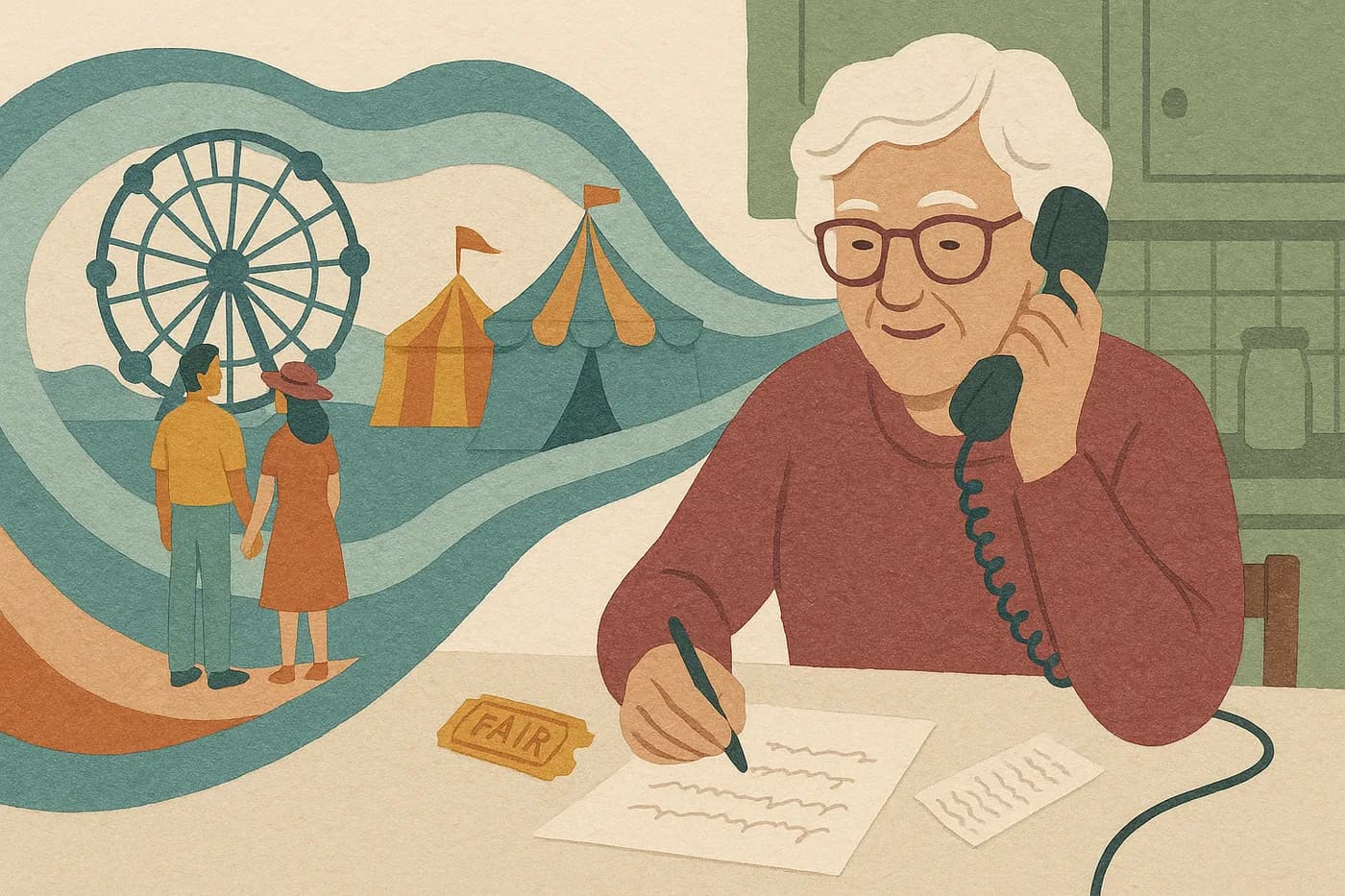
Most of what fills a companion entry comes from asking a relative about a specific item rather than asking them to summarize a life. "What do you remember about this" works better held next to the actual object or a photo of it than asked in the abstract — a physical thing in someone's hands tends to produce a specific memory, where a general question tends to produce a general answer.
That conversation deserves the same care as any other family interview. It's an invitation, not an extraction: let the person set the pace, follow whatever detail they land on rather than steering back to a script, and accept a "I don't actually know why we kept that" as a complete and useful answer. Some objects will stay partly unexplained, and the entry is more honest recording that than forcing a confident story onto a thing nobody can fully account for anymore.
When two relatives remember the same object differently
An object that passed through several hands often collects more than one story — one cousin is certain the ring belonged to a great-grandmother, another is just as certain it came from an aunt by marriage. A companion entry that resolves this by picking whichever version sounds more confident isn't more accurate; it's just quieter about the disagreement. The Oral History Association's published guidance on narrator review — letting the person who gave an account see it recorded and correct or add to it before it's treated as settled — applies just as well to an object's story as to a spoken interview. Where two accounts genuinely conflict and neither can be confirmed, the entry can hold both, named by source, rather than declaring a winner.
Protecting the original while you use it
A page built from real letters and objects raises a second question craft guides tend to skip: whether to place the original item on the page at all. Acid-free, archival-quality paper and adhesives are the standard craft recommendation for anything meant to last decades rather than years, because ordinary paper and tape discolor and degrade the material touching them. For anything irreplaceable — a single letter, a one-of-a-kind photograph — the more durable approach is usually a high-quality copy on the page itself, with the original stored flat, unfolded, and separate from light and humidity. The scrapbook can still show the object. It doesn't have to be the object's only surviving home.
Where this fits
A scrapbook is one way to hold this material, not the only one, and it works best as a rendering of a larger record rather than the sole copy of it. The archive is the product, not the book makes the broader case for keeping the underlying conversations, objects, and disagreements as the lasting archive, with any bound or assembled version — a scrapbook included — treated as one export of it.
Joan holds the same distinction a good provenance entry does: a family story and a documented fact are different kinds of evidence, kept as what they actually are, with nothing added to a family's archive until the person who told it has approved what's there.
If your family has a box of objects and no fixed place yet to put the story that goes with each one, join Founding Families.