
Conversations
Questions to Ask Your Grandparents Before They Die, Asked With Care
A short, humane list of questions to ask your grandparents before they die — three to start with, and how to ask them without turning a visit into an interview.
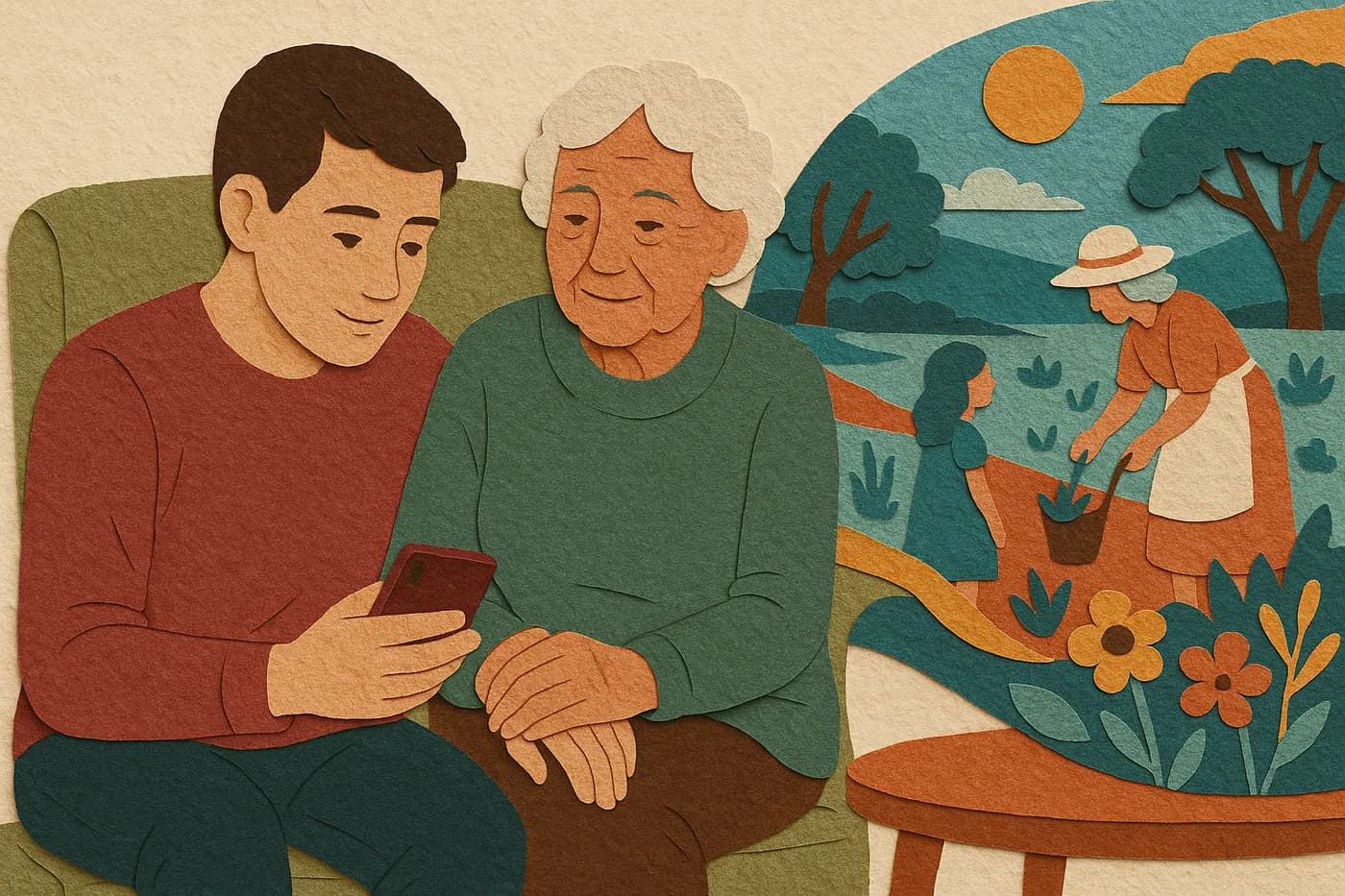
A visit to a grandparent who does not have long left can turn into an assignment without anyone meaning it to — a list to get through, a recorder to remember, a feeling that this conversation has to accomplish more than an ordinary one. It rarely needs to. The questions to ask your grandparents before they die are usually shorter and gentler than people expect, not longer and more urgent.
Ask two or three specific questions rather than working through a list: one about a person only they can describe, one about a decision they still remember making, and one open invitation — what they want remembered that nobody has thought to ask. Follow whatever comes back further than the question itself. Stop the moment a subject is declined, and do not save the hardest ones for a single visit. A short conversation held with attention outlasts a long one held as an obligation.
Why fewer questions work better here
A complete list of every question worth asking a grandparent already exists, and it is the wrong tool for a visit where time or energy is limited. A long list turns a conversation into an agenda, and an agenda is precisely what makes a hard visit feel like extraction — something being taken, rather than something being shared.
The alternative is not a shorter version of the same list. It is choosing on purpose. Three real questions, each followed all the way to wherever it leads, produce more than fifteen that each get one sentence before moving on. That is true of any conversation, but it matters more here, because attention and stamina are often the scarcest things in the room.
Which questions to ask your grandparents before they die
Three kinds of questions do most of the work, and each one exists for a different reason. Keep this as a short card — three lines, not a page — for a visit or a phone call.
| Ask about | Why this one | A way to phrase it |
|---|---|---|
| A person who exists only as a name | Once they are gone, so is the last person who remembers this person as more than a name on a tree | "Is there someone you loved that the rest of us never met — what were they like?" |
| A decision they still feel, not just remember | The outcome is known to everyone; what it felt like before it was known usually is not | "What is a decision that changed everything for you — what did you think would happen at the time?" |
| What they want remembered | It hands the agenda to them instead of to the list | "Is there something you want remembered that nobody has thought to ask you?" |
The third question does something the other two cannot: it lets a person correct the whole conversation if the first two missed what actually mattered to them. Ask it last, and mean it as an honest question rather than a closing formality.
How to ask without it feeling like an interview
Ask before recording anything, even a phone's voice memo — a plain "do you mind if I keep this" is enough, and it matters here more than in an ordinary conversation, because consent asked for plainly is part of what keeps a hard conversation from feeling taken rather than given. The Oral History Association's published guidance on narrator consent and review treats this as a baseline, not a formality, even for a family conversation with no professional interviewer involved.
Ask one question, then leave room. The temptation, especially when a visit feels finite, is to fill every pause with the next question. Resist it — the pause is usually where the actual answer is still arriving.
The best follow-up is rarely a new question. It is "what happened next," or silence held a beat longer than feels comfortable. And some doors will stay closed. A short answer followed by a change of subject is a boundary being set in real time, not a failure of the question — write down that the door was there, and do not push on it again in the same visit.
Stop before anyone is tired, not after. A hard conversation that ends on time gets a second visit. One that runs past the point of comfort often does not.
Adjust to hearing and energy — not to a diagnosis
If a question needs repeating, or a longer story tires someone out faster than it used to, that is ordinarily a hearing or stamina issue, and it deserves the same patience either would get: speak clearly, keep sessions shorter, and let a shrug end a topic without treating it as a sign of anything more. Do not infer a cognitive condition from a short or foggy answer, and do not offer care advice — a grandchild asking questions is not the person positioned to assess what a vague answer means. If something about a conversation genuinely concerns you, that is a conversation for the people already involved in someone's care, not a conclusion to draw from one visit.
Write down what's said, and what's uncertain
A remembered account is not the same thing as a verified fact, and that is truest of exactly the stories being asked for here — the ones nobody else can confirm anymore. If a detail contradicts what another relative remembers, write down both versions rather than quietly picking the one that sounds more certain. Read back what you wrote to the person who said it, when you can — the same narrator-review principle the Oral History Association recommends for recorded interviews works for a page of notes taken by hand.
Where this fits
This is the short version, built for when time or energy is limited. Questions to ask your grandparents covers more ground — rooms, routines, people, and ordinary details — for the conversations that have more room to unfold. And because so much of what makes this kind of conversation feel safe rather than extractive comes down to consent, nothing enters the archive without approval explains what that actually means in practice, before and after a story is recorded.
There is no countdown to manage here, and no version of this that has to happen in one sitting. If your family would rather someone else held the pacing and the follow-up across many ordinary phone calls instead of a single hard one, join Founding Families to see how Joan does that.