
Family stories
What Joan does with a story the family already tells every holiday
The flood, the blackout, the wrong turn with the whole wedding party in the car — a story everyone already knows by heart is not the same as a finished one.
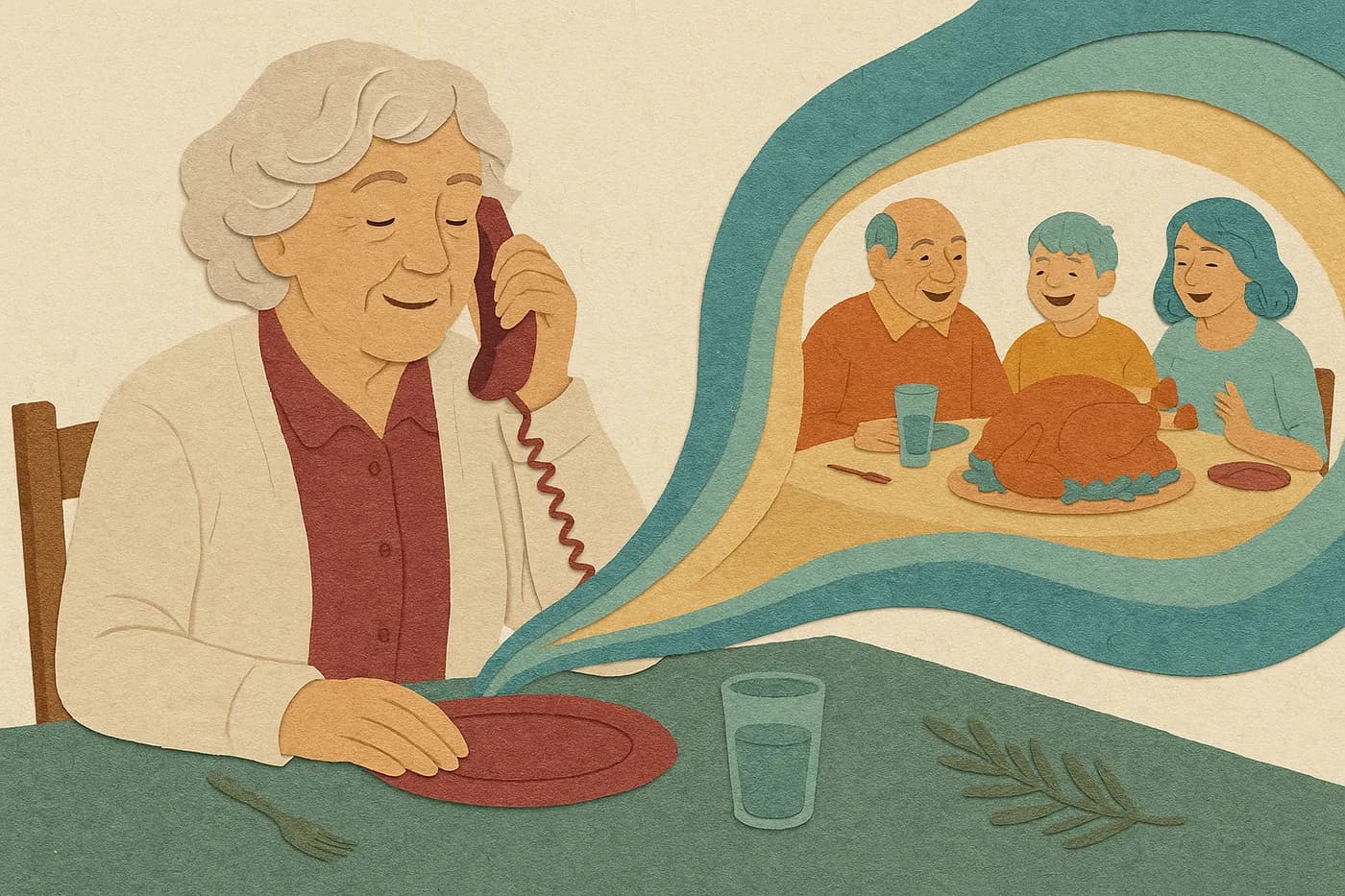
Every family has one. The flood, the blackout, the wrong turn down a one-way street with the whole wedding party in the car. It comes out at the same table every year, in almost the same words, and by the third telling a grandchild can do the voices before the grandparent gets there. Ask why anyone should bother recording it, and the honest answer from most families is: we already know this one by heart.
Joan does not skip the story everyone already knows, and does not ask a storyteller to prove it deserves a slot next to something "new." A version the family has heard for twenty years is treated as a starting point, not a finished record. The interview asks about the ten minutes before the familiar part starts, who else was actually in the room, and what has quietly changed about the telling since the first time. When two people remember it differently, both versions stay, rather than one being declared the true account.
The polished version is not the complete one
A story told at every holiday has been edited the way any performance gets edited — not on purpose, but through repetition. The parts that land stay in. The parts that slow the story down get trimmed. After enough tellings, what survives is a tight, reliable shape: setup, complication, the line everyone waits for. That shape is real, and it is worth keeping exactly as it is told. It is also, almost by definition, missing whatever never fit inside it.
What is missing is rarely a secret. It is usually just unglamorous: what the kitchen smelled like that night, who was too young to remember it firsthand and only knows the story secondhand, what almost happened instead, or the small mistake the person telling it has quietly left out of every version for thirty years. None of that competes with the version that gets the reaction at the table. It also is not in the version that gets the reaction at the table.
What gets asked instead of "tell it again"
A recorded conversation can sit somewhere a live holiday performance cannot: in the run-up and the aftermath, not just the highlight. Instead of asking for the story again, the more useful question is about its edges — the part right before it starts, the part right after it ends, the people watching who never get a line in the retelling. None of that has to replace the version everyone loves. It sits alongside it, filling in what a story polished for an audience never had room for.
Four questions for a story that has already been told a hundred times
- What happened in the half hour before this starts? Performances open at the interesting part; the setup is usually the first thing trimmed.
- Who else was in the room, and would they tell it the same way? A second account is not a challenge to the first one. It is more of the record, not a correction to it.
- What has changed about how you tell it now, compared with the first time you told it? A story performed for twenty years is not the same shape it started in, and the difference is itself worth keeping.
- Is there a part you leave out? Most well-worn stories have one — a detail that is not dramatic, just slightly embarrassing or slightly sad, that quietly dropped out somewhere around the sixth telling.
When the family does not agree
Even the most familiar story is not always agreed on. One sibling remembers the power was out for two days; another remembers one long night. Joan does not referee that into a single approved account. Both memories are kept, attributed to the person who holds them, because a remembered account is not a verified historical fact for either sibling — it is what each of them carries. Published guidance from the Oral History Association for interviewers rests on the same principle: the person being recorded reviews and can correct their own account, but no one is in the business of certifying whose memory is the official one.
Why the familiar story is still worth doing
If the goal were a complete, non-redundant archive, the story everyone already knows might genuinely rank low — the family already has it, more or less. But that is not what a family archive is for. The story told at every holiday is exactly the one grandchildren will still be repeating in forty years, usually with less texture attached each time it is retold from memory of a memory, unless a version exists somewhere with the smell of the kitchen and the actual mistake still in it. A recording does not replace the performance told at the table. It sits underneath it, holding what the performance has never had room for.
Where this leads
How a family's stories keep shifting with every retelling, and what that means for capturing several accounts of the same event well, is the subject of family storytelling — a useful next stop for anyone assembling more than one person's version of an event.
If the story your family already knows by heart is one you would rather not lose the rest of, join Founding Families.