
Family stories
Gifts for Parents Who Don't Want Anything: Take Them at Their Word
Parents who say they don't want anything usually mean it. What the instruction actually rules out is objects — not attention, and not being asked about something nobody has asked about in years.
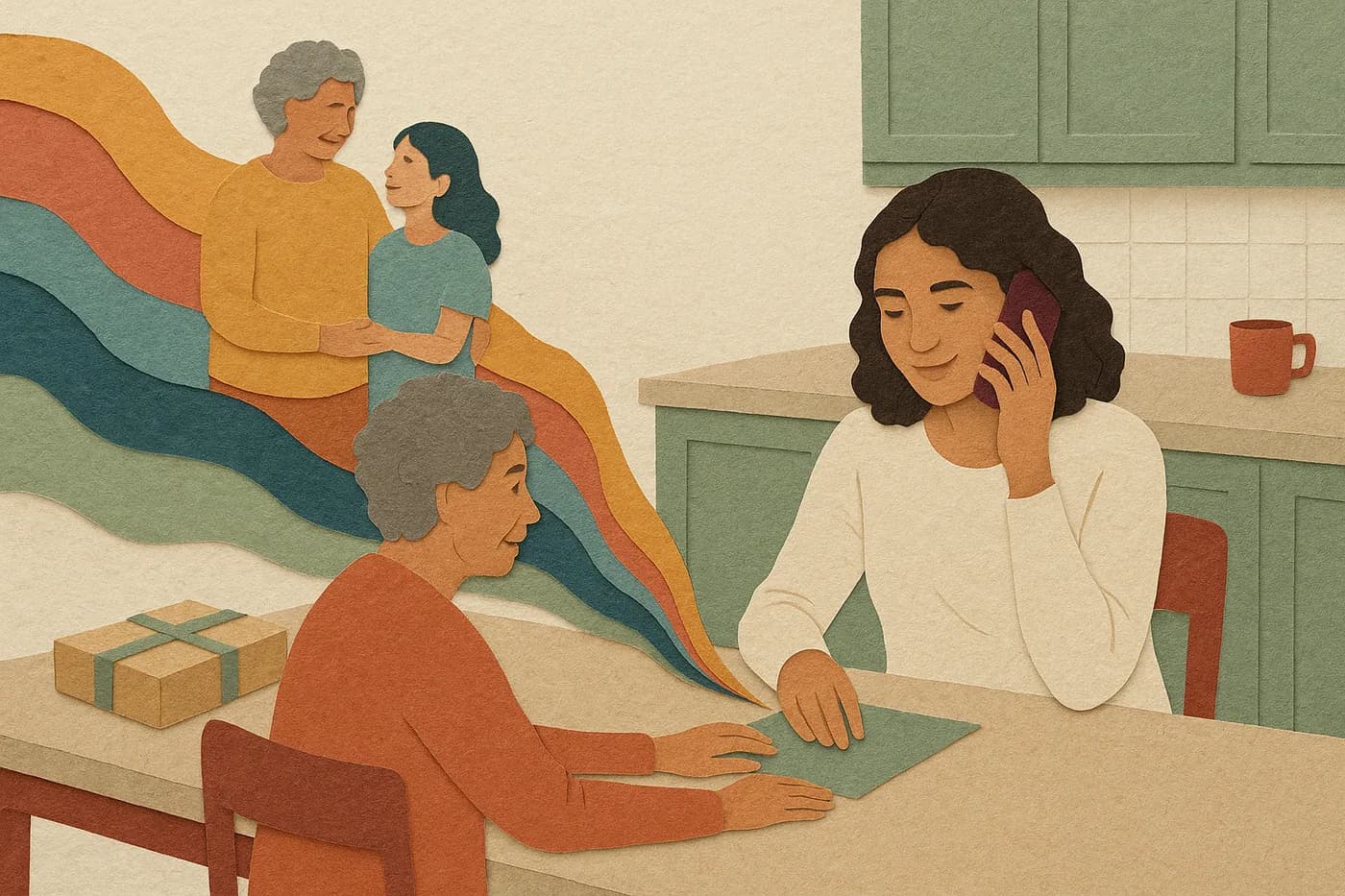
Most gift guides treat "I don't want anything" as an obstacle to route around — a polite noise to be overridden with something thoughtful enough. It is usually not that. It is usually accurate, and it is usually specific in a way that is worth listening to.
Parents who say they don't want anything almost always mean they don't want another object, and often that they don't want money spent on them. Neither of those rules out attention. The gifts that survive the instruction intact are the ones that add nothing to the house, cost the recipient no energy to receive, and give the family something it did not have before.
Why the instruction is usually sincere
There are three different sentences hiding inside "don't get me anything," and they call for different responses.
The first is about volume. Someone who has been accumulating for forty years is not short of objects, and a new one is a small burden — a thing to find a place for, dust, and eventually decide what to do with. Adding to that is not generous.
The second is about money. Parents frequently do not want their children spending on them, particularly once the children have their own costs. This one is often the real message, and it is the one most gift guides ignore entirely, because the guide's business model depends on ignoring it.
The third is about fuss. Some people simply do not enjoy being the centre of an occasion. Being handed something in front of an audience, and having to produce the right face, is a cost rather than a pleasure.
Work out which one you are hearing. It narrows the field faster than any list.
What the refusal actually rules out
Objects. That is the whole of it.
It does not rule out your time, and it does not rule out being asked about something nobody has asked them about in years. Those two are almost never what a person is declining when they say they don't want anything, and they are the two categories most guides skip, because neither can be shipped in a box.
This is worth being concrete about, because "give them your time" is the kind of advice that sounds warm and produces nothing. A vague intention to call more often is not a gift. A specific arrangement, with a shape and a start date, is.
The three that survive the instruction
Attention with a structure. Not "we should talk more" but something with a time attached and an end. A standing weekly call. An afternoon set aside with no other plan. The structure is what turns an intention into something that actually happens in February.
Usefulness they did not have to ask for. The task they have been putting off because arranging it is the hard part — the gutters, the paperwork, the appointment that needs a phone call at an awkward hour. Doing the arranging is the gift; the task itself is incidental.
Something the family keeps. A record that did not exist before and will outlast the occasion. Photographs organised and labelled while there is still someone to say who is in them. A recording of a parent telling the story everyone half-knows. This is the category that gets more valuable every year rather than less, which is unusual for anything given at Christmas.
If they mean it about the money too
Then the third category is the one to look at, because the good version of it is free.
Sit down with a parent and ask about one specific thing — a room, a decision, a person you never met — and record it on your phone with their permission. That costs nothing. It takes an afternoon. And it produces the one item on any gift list that no amount of money buys later, once the person who remembers is not available to ask.
Most families do not do this, and the reason is not indifference. It is that there is never an obvious occasion for it, and it feels strange to announce. A holiday removes that problem: there is already a reason to be sitting down together with nowhere else to be.
The handover problem
A gift that is not a thing still has to be given, and this is where the good intention usually collapses.
Say it out loud, or write it on a card, in plain language. Be specific about what it is, when it starts, and what the other person has to do — which should be as close to nothing as you can make it. "I've arranged for someone to call you and ask about your life, starting in January, and you can stop whenever you like" is a gift with edges.
The same idea left vague — "I want to record your stories sometime" — is not a gift. It is a plan, and plans of that kind reliably do not survive contact with January. If you cannot say when it starts, it has not been given yet.
When they mean it completely
Some people mean all of it, including the attention, and that is a real answer rather than a puzzle to solve.
If a parent has said clearly that they do not want an occasion made of them, making one anyway is not generosity. Ask, do not surprise. "Would you like this?" costs a little of the theatre and removes almost all of the risk, and for the people who say don't get me anything and mean it, being consulted is closer to the gift than anything that could have been wrapped.
A refusal is also not permanent. Someone who does not want this in December may want it in June, when nothing is being asked of them and there is no audience.
Where this leads
If the difficulty is that they lack nothing rather than that they have refused, a gift for parents who have everything sorts the non-object options by the job each one performs. For older parents, where energy and mobility change what a good gift is, gifts for elderly parents that create time, comfort, or connection covers the same ground with those constraints in front. And if the third category is the one that interests you, preserving a parent's stories without giving them homework is about how to do it without turning it into a project they have to complete.
Joan is one version of that third category: a standing conversation by phone, paced over weeks, with follow-up built in, and nothing entering the family archive until the person telling the story has approved it. It asks nothing of the storyteller except that they answer the phone and talk.
If that sounds like the right gift for your family, join Founding Families.