
Family stories
How to Make a Family Recipe Book That Preserves the Stories Too
A family recipe book that only holds ingredients loses the part that made the recipes worth keeping. What to record alongside them, and how to collect it without turning it into a project.
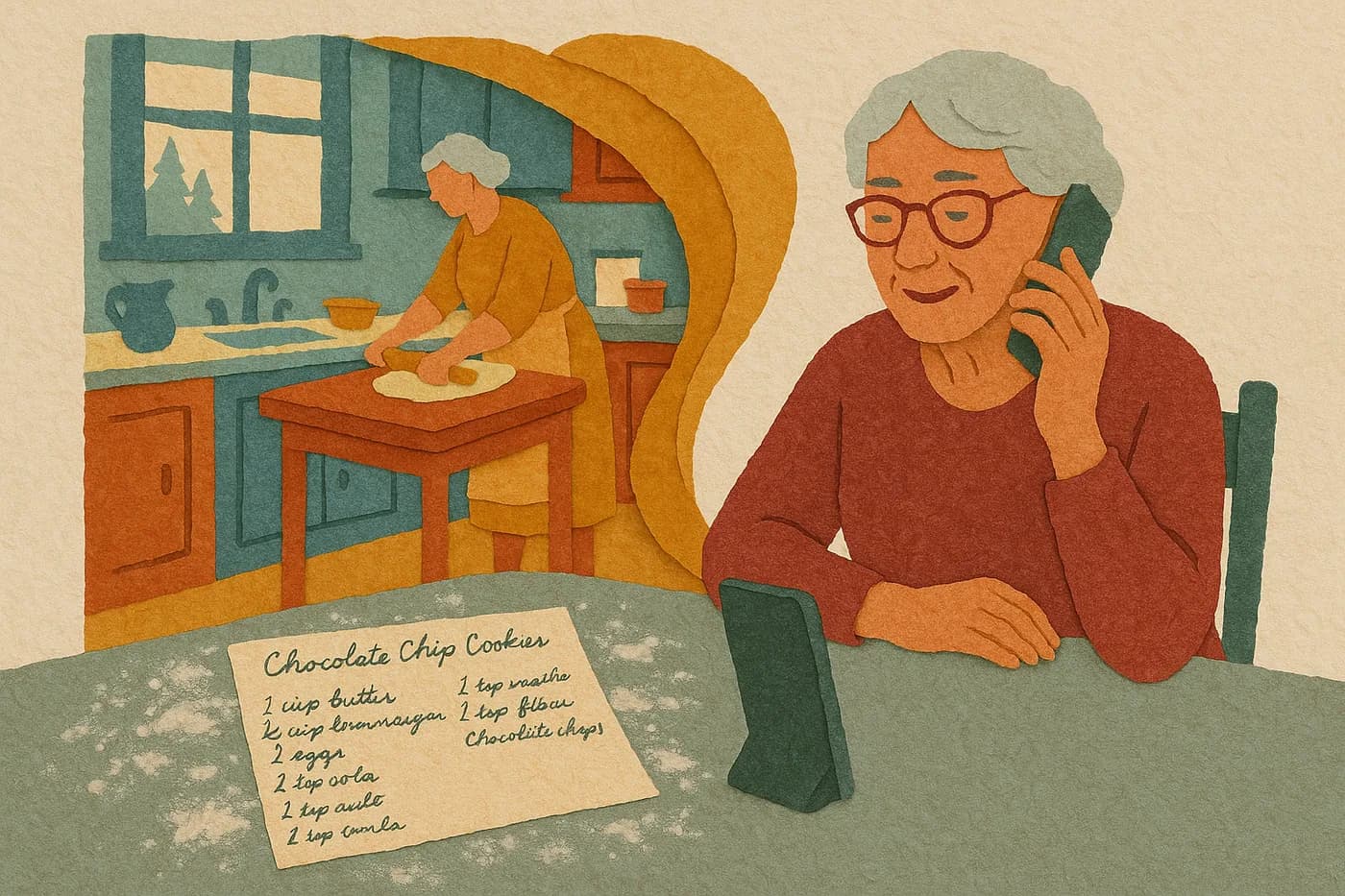
The recipe is the easiest part to save and the least interesting thing on the card. Anyone can reproduce a casserole from a list of ingredients. What disappears is everything the list does not hold: which occasion it belonged to, what got substituted the year the shop had none, who taught it to whom, and the fact that two people in the family remember it differently and always have.
A family recipe book worth keeping records the recipe and the four things around it — the occasion, the substitutions, the lineage, and the disagreement. Collect those while the person who knows them is still cooking, because none of them are recoverable from the card afterwards.
Why the ingredients are the part that survives anyway
Ingredients are robust. They get copied onto index cards, texted between siblings, and half-remembered accurately enough to work. If a recipe matters to a family, the quantities usually make it to the next generation on their own.
The context does not. It lives in one or two heads, is never written down because it is not information anyone thinks of as information, and goes at once. Ask anyone who has inherited a recipe box: the cards are there, and nobody can say why one is marked with an asterisk, or who "M." was, or which of the three lasagne cards is the one she actually used.
That asymmetry is the whole argument for how to spend your effort. Photograph the card in five seconds. Spend the twenty minutes on everything the card does not say.
The four things to record alongside each recipe
The occasion. Almost every kept recipe belongs to something — a holiday, a birthday, the thing made when someone was ill, the thing made when there was no money. A recipe with its occasion attached is a story; without it, it is instructions.
The substitutions. These are where the real history sits. What went in when an ingredient was unavailable, unaffordable, or out of season, and which of those wartime or lean-year substitutions became the permanent version because everyone got used to it. A surprising number of "authentic" family recipes are actually a shortage that stuck.
The lineage. Who taught it to whom, and where the chain starts, as far back as anyone can honestly say. Be careful to record the limit of what is known rather than smoothing it — "she said it came from her mother, but nobody is certain" is more valuable than a confident invented origin.
The disagreement. Whether anyone in the family makes it differently, and what they would say about your version. This is the one most people leave out because it feels like an argument. It is not; it is the evidence that the recipe has been alive in more than one kitchen.
Keep the handwriting
Transcribe for usability, and photograph for everything else.
A typed recipe is easier to cook from, and a scan of the original card carries information a transcription cannot: the handwriting itself, the splash marks that show which recipes were actually used, the crossings-out, the note in a different hand added years later by someone else. Those are the parts that make a grandchild stop on the page.
The practical version is both. Photograph every card flat, in daylight, before anything else happens to the box. Then transcribe at leisure. If you only get to do one, do the photographs — transcription can happen any time, and the cards are the thing that gets lost in a house clearance.
When two people remember it differently
Do not resolve it. Record both.
The instinct is to establish a correct version, and it is the wrong instinct. Two aunts who each insist the other one adds too much cinnamon are not a problem with your recipe book; they are the most interesting page in it. Write down both versions, attributed, along with what each of them says about the other's.
The same applies to origins. If one person says the recipe came over with a great-grandmother and another says it came off the back of a packet in 1974, both claims go in. Marking a disagreement is honest and takes a sentence. Declaring a winner invents a family history that the next generation will inherit as fact.
Collecting them without making it a project
The failure mode of a family recipe book is not that it is hard. It is that it becomes an assignment issued to an eighty-year-old, and assignments do not get done.
What works is the opposite: one recipe at a time, asked while something is already happening. The best time to ask about a dish is while it is being made, because the answers come out as narration rather than recall — no, you want to wait until it stops spitting, your grandmother used to say — and that sentence is worth more than any answer to "tell me about this recipe."
A phone on the worktop, with permission, catches all of it. You are not conducting an interview; you are keeping someone company in a kitchen and letting the recording run. Twenty minutes of that per dish, across a few visits, produces more than a year of intending to write things down.
A page for each recipe
Whatever format you eventually use, each recipe wants the same fields. This is the whole template:
| Field | What goes in it | Why it matters |
|---|---|---|
| Name | What the family calls it, not what a cookbook would | The family name is the one a grandchild will search for |
| Made for | The occasion, season, or situation it belongs to | Turns instructions into a story |
| From | Who taught it to whom, and where the chain stops | Records lineage and its limit honestly |
| Ingredients | As actually used, not as idealised | The working version, including the shortcuts |
| Substitutions | What changed, when, and whether it stuck | Where the family history actually lives |
| The tell | The thing you only know from watching — texture, sound, timing | The part no written recipe carries |
| Disputed | Who makes it differently, and what they say | Keeps more than one kitchen in the book |
| Source image | Photograph of the original card, if one exists | Handwriting, stains, marginal notes |
| Recorded | Date, and who was in the room | Provenance, and who to ask next |
The last two rows are the ones people skip and later wish they had not.
What to do with the recordings
Keep them. A recipe book is one rendering of what you collected, and it is not the durable part.
The audio holds the phrasing, the pauses, the laugh at the story about the year it went wrong — none of which survives being turned into a paragraph. Keep the original files somewhere the family can actually reach, alongside the transcriptions, and treat the printed book as an export rather than the archive itself. The archive is the product, not the book makes that case at length, and it applies to recipes more sharply than to most material, because a recipe book is so obviously a physical object that it is easy to forget the recordings exist.
Where this fits
A recipe book is one of the easiest places to start, because there is already a reason to be in the kitchen together and nobody has to sit down formally for anything. If it goes well, the same approach scales: how to make a family history book people will actually read covers the larger version, and a family memory book should keep stories, not just answers is about what separates a book people reopen from one filled in once.
If the difficulty is that the person with the recipes will not sit for an interview, preserving a parent's stories without giving them homework is about the version where nothing is ever announced as a project.
Joan does this for whole lives rather than single dishes — a standing phone conversation, paced over weeks, where the follow-up questions get asked and nothing enters the family archive until the person telling the story has approved it. The recipes tend to come up on their own.
If that sounds useful for your family, join Founding Families.